


Pyramid in the land of the yurts
Pyramids fascinate me. And it’s nothing mystical.
Pyramid (Alternative name: Mid)
I remember that Golite paper catalogue (yeah, paper… it’s been a long time) I got hold of that was like a revelation to me: it was full of gear and apparel that was unorthodox and different. Among all that, what I felt as an anachronism: a pyramid shaped tent. I thought this was an old design, no longer in use. There it was, however, outstanding in that ground-breaking catalogue.
I wanted to buy nearly everything except that tent whose presence there I didn’ t understand: “It’s too tall” I was thinking, “it’ll be awful in the wind”
(Some time later, I bought that very tent. I still have it and it’s my tent of choice for two. I can’t think of anything better)

The perfect shelter
My next eureka moment with pyramids came shortly after while I was reading “The Advanced Backpacker” by Chris Townsend: there is this pic of the author’s flat, rectangular tarp pitched in a pyramid shape, ready to take on the weather:

The Advanced Backpacker, Chris Townsend, page 151
It was looking solid. Then, I understood.
Be water, my friend (the perfect geometry)
Despite the stale quote, Bruce Lee was right and this is particularly true when out there, where nature rules: opposing it goes nowhere; it’s better to adapt.
Other than flooding, meteorites or drunk users, the big factor affecting tents is the wind. Opposing wind equates to building a very strong structure. Adapting to it equates to trying to go unnoticed, letting it slide away.
A pyramid is inherently aerodynamic. It’s tall indeed but its footprint area gets dramatically smaller the higher the horizontal cut. If wind hits, the sloping wall diverts it upwards. As it goes higher, the pyramid’s profile gets narrower and the upward current is left with no opposition: it slides forward and leaves the obstacle behind.

One dimension…
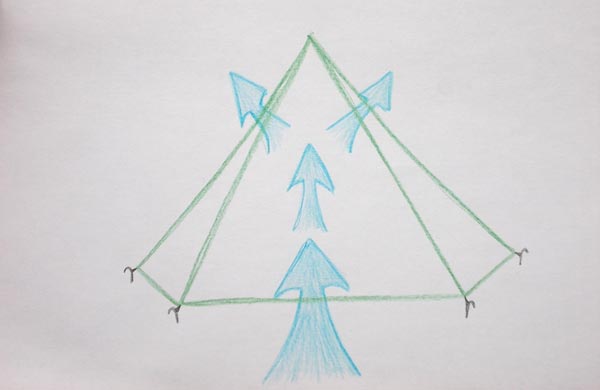
The other dimension
The pyramid offers a path of less resistance that the wind will follow, just like in Lee’s analogy.
The implications of this are huge: since the pyramid is inherently robust, it can be made simple, light and spacious. All at the same time. Sounds convenient for a portable shelter.
Simple
A pyramid has 3 basic parts: a shaped tarp, a pole and a set of stakes. It’ll also need some kind of opening to allow for honorable entry/exit. A separate floor is usually part of the deal.
That’s it.
It may offer detail features like a ventilation system, facilities for hanging stuff inside or a complete inner tent if a double wall system is required.
This all is still light years far from the complexity of what we nowadays take as a classic tent design: no multiple, long poles, no sleeves or clips to join frame and fabric and the number of fabric pieces and the seams to join everything together will be much lower.
Light
Complexity is what usually makes things heavy. In shelter systems, the frame is a good part of the complexity and the weight, followed by the fabric unit weight and the accessories, some more useless than others, that might be added. A pyramid is so simple that it’s inherently lightweight. If low weight is also part of the designing goal, final weights can get much lower than in a traditional design, other factors being equal.
Spacious
The challenge with a pyramid would be to make it small anyway. The geometry is a better fit for two and beyond. Its footprint is huge compared with that of a traditional tent of similar features. Not all that area is equally usable due to the slanted walls but this makes a convenient fit for people and gear: the central part for the people, the periphery where the vertical space is smaller fits gear perfectly and makes for a good storage room. In the central staying room, you can comfortably sit down, stretch or move around. In larger pyramids you can almost stand.

Comfortable breakfast inside if it’s cold or raining outside
This is not all, there’s more:
Robust
A pyramid has little to break. The paradigm of robustness.
The pole is straight so it works in a more convenient way than those frame poles that must bend. Forces on the pole are mostly vertical so they apply where the pole is strongest.
The tarp has few seams and straightforward tension lines: it’s difficult to over-tension a pyramid by mistake and if it happens it’ll be along the ridges which are built to stand the tension.
Easy to set up
Even in the wind. Nothing to fit into place, no need to deal with an impromptu kite: just stake down, slide the pole beneath the fly and raise. Voilá, pyramid.
How and why it works
Under a single pole pyramid there’s no frame holding the shape. Only the pole supports the shelter and only the applied tension holds the pyramid shape.
Ridges must be heavily reinforced to be able to take all that tension. This also generates another requirement: ground holds must be solid. loose stakes won’t work.

Loose soil
Ridge tension will be our virtual frame. It’s an unbreakable and very elastic frame: if it bends, it’ll always spring back.
In actual use, it is worth revisiting what happens when conditions are challenging:
Rain
This one is easy: properly sealed seams and a good pitch are enough to stay dry inside. Good site selection is needed as much as for any other kind of shelter.
Wind
The key factor here is the aerodynamic character of the design. The other key is in the tension:
With reinforced ridges and solid ground holds, the required action is to apply tension freely until the fly fabric is drum tight. The goal is that the walls don’t deform in the wind. If they would, we’d start having problems.
You can see a good example of how a pyramid behaves in heavy wind in the following vid:
Snow
The known problem with the snow is that it sticks and accumulates; and it’s heavy. There are two ways out of this: avoid accumulation and bearing the weight. Our single-pole pyramid is quite good on the former, not so on the latter.
The slanted walls help the snow slide down. Slippery fabrics like silicone coated ones also help.

Pyramids do well in the snow
Limitations
Same breakdown:
Wind
The wind can be strong enough to deform the windward walls. It can also deform the ridge lines. This would compromise the shelter’s integrity but it’s not yet the end of the world: the pyramid will spring back to shape as soon as the gust eases. If it doesn’t, problems start: a deformed pyramid will lose part of its aerodynamic shape and this will concentrate load and stress in certain points and elements.
The fly is not expected to break, not as a direct consequence of the wind force. The weak link is usually the most rigid, less elastic element: the pole. A broken pole may in turn cause a fly fabric rip.
Another potential weak link is the stake down loop attachment. These elements will be heavily reinforced because they take maximum tension.
The elasticity of a single-pole supported pyramid is both a blessing and a curse: it helps the shelter adapt to the conditions but it also inflicts extra, localized pressure that may cause failure. There’ll be a certain wind speed from which a more heavily structured shelter system will be needed. I don’t know which one that is.
Snow
Despite the slanted walls and possible fabric slipperiness, snow will stick. Once stuck, it gets easier to accumulate, causing deformation in the virtual frame and structure overload. If it keeps snowing, the pyramid will collapse.
Upon a heavy snowfall, the only solution is to tap from inside to avoid heavy accumulation. Not possible to sleep through.
The state of things
Current doctrine favors solid frames when wind is the issue. The more wind expected, the heftier the frame.
This is not necessarily wrong. Heavily framed tents will work and this may make sense when the issue is so critical.
The problem with the doctrine is it’s rather bold. It takes an option and the rest virtually disappear so most of the audience is not even aware there are other options. Mass production needs uniformity. If you need wind resistance, you get a frame. If you need more wind resistance, you get more frame and that’s it. As far as the general public goes, pyramids don’t even exist.
Pyramids do exist
It wasn’t long ago that pyramids became relatively popular with a certain fringe users niche but not anywhere beyond. They would work for a much wider audience but most potential users don’t have access to the information.
Basic design/use features
If you are already familiar with pyramids, you may skip this section on to the advanced features.
Modularity
Pyramids are perfectly suited for a modular design. This is very interesting: it allows use as a double-skin tent, as a single-skin tent or as a simple, shaped tarp.
Fly, pole and stakes alone would make a sort of pyramid-shaped, floorless tarp. This can be ridiculously light, particularly if a hiking pole is used as the vertical support.

Fly only and a hiking pole: already a tent
The addition of a separate floor would make a true single-skin tent. The floor does not need to be part of the structure so it can be independent from the other elements. It can be simply laid out or it can be connected to the same stakes in use by the fly for a wrinkle-free, it-won’t-move arrangement. It can even be in a bathtub shape provided the fly has some matching loops to hang the upper edge from.
A fully closed inner tent can also be used for a full, double-skin end tent. As with a separate floor, the inner tent is not a structural part. The inner tent can be mesh or solid. In most implementations, the inner tent comes with a floor: joining them would be too much complexity for little gain if they came separate.
In a floor-less or single-skin flavor, pyramids may have a netting skirt from the lower edge perimeter down to the ground for insect-proofness. Many flying insects tend to gather at the top when they get in but I can understand how a flying insect-free space may be a blessing in certain conditions.
Ventilation
It is built-in around the lower perimeter but most pyramids also have a ventilation window near the apex. It is probably a good idea as it doesn’t add much complexity or weight and it may help upward draft that might take some extra humidity out.
Additional tie-outs
One tie-out point per ridge end is all the pyramid strictly needs. Some additional ones may be useful for most challenging conditions. Every tie-out point creates new tension lines that will help with the structural integrity of the shelter.
The most typical extra tie-outs are those found along the lower perimeter, not at the ridge end but somewhere in the middle of each side. There is almost no reason to not adding them as only a webbing loop is needed and it would be sewn in an already reinforced area.
Mid-height tie-outs can be found on the ridge itself or somewhere mid-panel. The latter would need reinforcement as they would mean tension in an area that was not meant for that.
Center pole
It is the only vertical support. In most pyramids, it is rather long. It will need to be a hefty one to avoid bending that could lead to breakage.
Hiking poles are usually fine for this, allowing a perfectly complementary dual use. If one pole is not long enough, two can be joined or an extension can be used. The extension is usually a simple tube whose section matches the pole tip’s. There used to be commercial versions of this.

A hiking pole as vertical support for the pyramid
Vestibule
If a pyramid is big enough, it is easy to reserve the entrance area as a vestibule: use a floor whose footprint is smaller than the fly’s or just detach the floor in that area and fold it back. This latter way, there’s always the choice of covering the whole footprint back. A vestibule may come handy for storing wet or dirty things or for cooking safely inside.
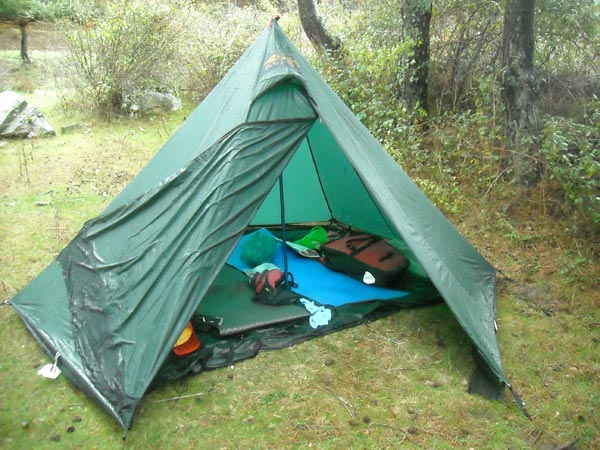
Folded back floor for some vestibule space

Comfortably cooking inside when it’s not nice out
The best compromise
In my opinion, a single-skin mid (with a netting skirt if flying insects are a potential problem) and a detachable floor. A full inner needs a lot of fabric and makes the whole set unnecessarily heavy. The insect protection is easy to get with the (much lighter) skirt. The single-skin version is more prone to condensation but mids are so spacious that this is seldom a problem. It will not unless it really drips on you, which is rare.
Advanced design features
If you skipped the basic features part, you may rejoin here. The following parts are not so obvious.
Entrance location
Ridge line entrance may look fine: there is a seam there anyway. However, this is a very bad design that’s surprisingly found in several commercial models.
Ridge lines are tension lines. Any opening/closing system (zip, velcro, others…) over a ridge line will be under tension. This makes closing particularly difficult and harmful for the closing system of choice. This will reduce lifespan and brings risk failure in the field.
Entrance systems must be located where there is less tension. This is mid-panel, that is, as far as possible from the tension lines. It is more robust, easier to operate and longer lasting.
Symmetry
Tents are for people so tent designs try to accommodate the shape and size of people and maybe their gear. Some pyramids are symmetric in all directions, others are made asymmetric to try to accommodate better the shape and size of the expected contents.
Four side footprint pyramids, for example, would be symmetric if the footprint would be square. Many of them however have a rectangular footprint trying to find an optimal fit. Other pyramids are designed so the unobstructed area is bigger on one side of the pole than on the other to avoid setting the pole at an angle. These pyramids would be asymmetric.
The lack of symmetry has a problem: if affects the aerodynamic shape of the pyramid. It is not the same anymore on all sides so the loads are not anymore equally distributed. Wall panels will be of different sizes, shapes and angles. Upon extra tension (like in heavy wind), there’ll be elements/areas that will be overloaded more than they would be in a symmetrical pyramid.
Number of sides
The bigger the number, the more aerodynamic the pyramid will be. The more sides, the smaller the panels will be and the unsupported area (in-between tension lines) will be equally smaller. There’ll be more tension lines to hold the tent’s shape.
On the other hand, the more sides, the more seams will be needed: more sewing and sealing work. More stakes for a basic pitch too but, at the same time, less need for additional stake-down points so this may be not so relevant.
At the time of pitching, it’ll be more difficult the more sides it has: it is easy to recreate a square on the ground before staking down, not so much with a hexagon or other shapes.
Lastly, the more sides, the easier it will be that there are small spaces left inside that are difficult to use.
The best compromise
It will depend on the size of the mid, both in height and footprint.
In a low pyramid, symmetry is less critical because it’ll be less vulnerable to wind. For a mid lower than 1.5 m, asymmetry is acceptable.
In small mids, like those for one person, the asymmetry makes some sense: a laying person is very asymmetric (much longer than it is wide). Furthermore, if the shelter is sized not only for the person but also for the gear, it makes sense to design two differently sized areas: a person takes more room than the gear.
For mids taller than 1.5 m (typically sized for two or more people), it’s better that the mid is symmetric: two laying persons are not so asymmetric (3 are almost square) and the possible space optimization doesn’t pay for the loss in wind resistance.
As far as number of sides go, it’s between 4 and 6. I don’t think more than 6 would be worth it unless for really big mids. Despite the relative popularity of 4 sided mids, I don’t think they’re the best option.
For one person, an asymmetric, pentagonal footprinted mid might be ideal: three sides for the occupant, two for the gear and vestibule area. A square, low pyramid may make sense too.
For two people, the hexagonal footprint is nearly perfect: half of the tent for each, with a “big”, rectangular area for the person by the side of the pole and a smaller area on the other side that’s just right for gear. It makes all the sense to place gear in a more exposed area and people closer to the center pole. Each person has access to its own gear and both have direct access to the entrance.
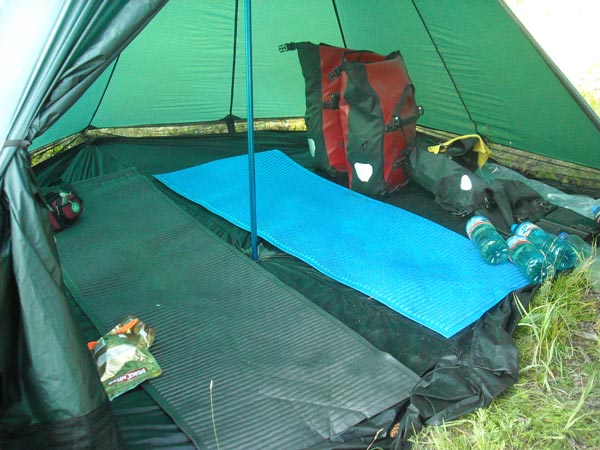
To the left of the dark grey mat there’s room just like on the right side
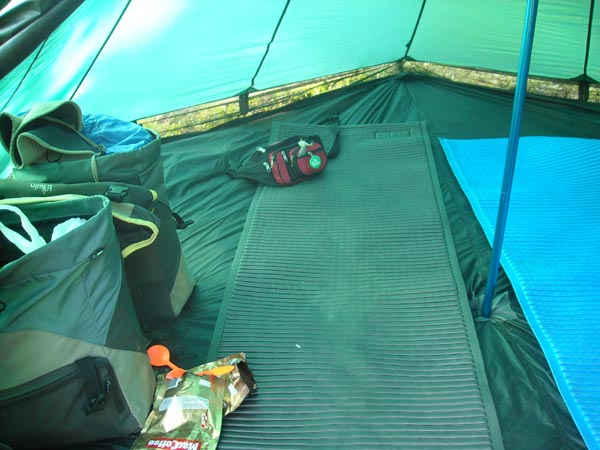
Left side
For more than two, a symmetric, square footprint may work best as far as room management goes. I’d recommend a generous size with the laying position diagonal to the square sides so the corners are available for gear and one of them can be used as a vestibule.
Special designs
Variable geometry
The possibility to adapt the pitch to the conditions is a very interesting feature typical from flat tarps. It is a powerful skill in the hands of experienced backpackers. This feature is mostly absent from pyramid designs which have a nearly fixed geometry.
Pyramids being aerodynamic and good performers in nearly all aspects, it may seem that the variable geometry is not really needed but it still is a powerful tool. And it just feels elegant.
Flat tarp, pyramid pitch
A flat tarp cannot take a pyramid shape naturally. A flat tarp has 2 dimensions; a pyramid needs 3. If a flat tarp is shaped as a mid, the perimeter length gets shorter and we are left with extra fabric that must be folded for anything like a taut pitch.
This is where Mountain Laurel Designs came with a brilliant idea: take the problem and make an outstanding feature out of it. The result was the Trailstar family of shelters.
Trailstars are flat pentagons. The designer’s master stroke was to take the perimeter slack in one of the sides and use it to set up an A-frame entrance.

A flat pentagon
The beauty of this idea is that we get a mid with no structural openings, the true missing link between flat tarps and mids. It joins the simplicity and robustness of a flat tarp with the wind resistance of a mid. It keeps part of the set up versatility of a flat tarp as it can be pitched not only higher/lower over the ground (any mid can do that) but it can also change its profile to be more flat and spread (lower height, bigger footprint) or the other way around, with the A-frame side taking the extra slack.

Littlestar, the small one in the Trailstar family
Trailstars are built to be rather low profile pyramids. When pitched taut, they’re extremely stable in the wind. This makes them very versatile, covering all kinds of grounds from open, airy setups in sheltered spots or mild conditions to bombproof pitches for exposed locations.
The entrance must remain open. This sometimes freaks some users out but certainly not those that were used to open tarps. It must be set up on the lee side and it’d probably require some action if the wind shifts.
Trailstars demand some skill and place responsibility on the user, just like any flat tarp. On a most positive note, they encourage this responsibility and become a very powerful tool in the hands of experienced backpackers.
Split mids
Split mids are an interesting idea in the realm of multi-use equipment and gear synergies.

Half green, half blue. The green piece on the righ half is the poncho’s hood
Rain apparel (namely ponchos/capes) are often tried as camp shelters. This multi-function is an obvious one as you will hardly need the item for both things at the same time. However, a normal size poncho is very small as a shelter. Doable but not comfortable. Fine for experiments or emergencies but not as a regular use idea.
Square/rectangular tarps can easily be set up as a half pyramid, with all the advantages of a pyramid… on just one side.

Flat, rectangular tarp set up as a half pyramid
A poncho may be too small for a stand-alone shelter but it may be fine, size wise, for half of it. Paired with a matching tarp, the resulting mid can be nicely sized resulting in a shelter system that’s lightweight, strong and spacious. And I find just elegant to multi-function like this.
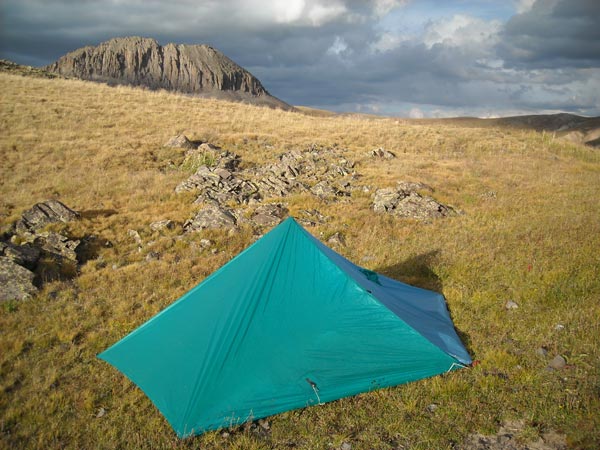
Voilá, Split Mid
I don’t know of any commercial product like this so I tried a DIY version. It was based on a rectangular tarp I had already made before and a poncho where respective lengths wouldn’t even match. The key outcome of the experiment is that despite the shabby implementation it worked well in all aspects: it was comfortable living for one and gear and it stood beautifully to bad weather that included a hail storm with heavy winds above tree-line in the Colorado Rockies.
A neat implementation of the idea would be based in two actual half-pyramids (a rectangular tarp is not) hoping that one of them would fit nice as a poncho/cape.
Using a poncho/cape as rain wear is not for everybody and it may be not ideal depending on the conditions. No poncho, no Split Mid. But thinking out of the box is always fine. Sometimes it may even turn out into something useful.
 RSS – Posts
Hobbs outdoors.
Thank you for your excellent article.Pyramid tents are probably the best light weight shelter, the four-sided ones are my favourite because they are so much easier to put up,especially in inclement whether.
J Hobbs.
Viajarapie
Getting a hexagon right is certainly more challenging than getting a square but you get better with practice and silnylon is quite forgiving, DCF on the other hand requires to get the shape very right for a viable pitch. I’m actually not even aware of any DCF mid with more than 4 sides.
Thanks for the comment, cheers