'/%3E%3Cpath%20fill='%23b2b2b2'%20d='M241%20382q0%2016%2017%2026%2017%2011%2042%2011t42-11q16-11%2017-26V269H241'/%3E%3Cpath%20fill='%239f7e00'%20d='M241%20379q0%2014%208%2023%209%209%2021%209%2014%200%2021-9%209-9%209-23V269h-59'/%3E%3Cpath%20d='M241%20339v-70h59v110q0%2014-9%2023l-6%205v-68h-15v72q-8%200-14-4v-68zm59%2040c0%2022%2015%2032%2029%2032%2021%200%2030-18%2030-32v-40h-59'/%3E%3Cpath%20fill='%239f7e00'%20d='M266%20277v5h2v12h-3v-5h2v-5h-9v5h2v5h-4v9h3v18h-5v10h34v-10h-5v-18h3v-9h-4v-5h2v-5h-9v5h2v5h-3v-12h2v-5zm42%20101q0%2010%206%2017%206%206%2015%207%2010-1%2016-7%206-7%206-17v-29h-43'/%3E%3Ccircle%20fill='%230044ad'%20cx='329.5'%20cy='372'%20r='6'/%3E%3Cellipse%20fill='%230044ad'%20cx='300'%20cy='340'%20rx='16'%20ry='21'/%3E%3C/svg%3E)
I was at this point in life where life itself told me it was time for a break. Come such time, I have it clear what I need to do is hike.

Along the Continental Divide
Why thru-hike
Thru-hike because this is what I do.
It’s the being out there for extended periods, the sleeping under the stars as the default option, the traveling through the land on my own devices, the living through the progress of the seasons, the connection with the environment that comes so naturally that it’s like I belong there, all through the basic act of walking that feels so inherently human.
There are a million things I could do in a 6 months gap time. I decided this time would be for me. Then, I hike.
Why the CDT
It feels like a natural progression from the PCT but 13 years later? I indeed hiked the Pacific Crest in 2006 and have been thru-hiking ever since as much as I had before but never again multi-month. Back then I had it clear my next extended hiking trip would be along the Continental Divide and even though other interesting trip plans pop up all the time, by 2019 the CDT idea hasn’t got old.
North America offers this great balance of wildness in a middle earth environment that’s so great for a trip where the focus is on the walking without turning suburban, as it inevitably happens in Europe where it’s difficult to not meet some kind of human made thing at the end of the day. In the North American West you can see nothing of the sort but the trail itself for days. Now picture that along 5000+ km and you’ve got the Continental Divide Trail.
The Continental Divide Trail

To have an idea of what the CDT stands for, picture following a watershed for three thousand miles where the closest you’ll get to any open sea is more than five hundred miles away as the crow flies. Walking along the spine of a subcontinent for five or six months.
The CDT is still a work in progress and still more a route than a trail, even though it seems to be progressing towards the latter. Route options are part of the fun and many of them are well documented anyway.
The CDT goes through big mountains in Montana, Wyoming and Colorado, yet there’s much more than mountains to it. It crosses iconic Yellowstone National Park and the fascinating Great Basin of Wyoming where the watershed is mostly a flat, how cool that can be?
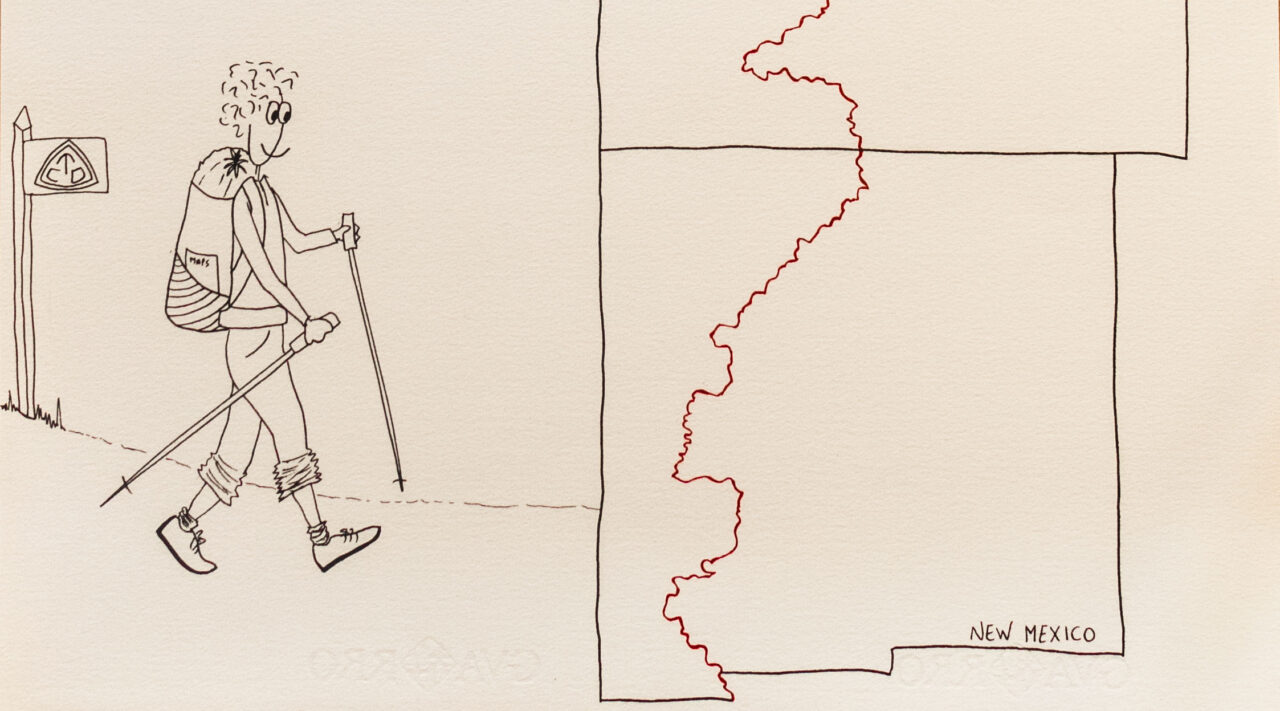
The southernmost section is across the high desert of New Mexico. I never thought I’d like hiking arid land until I did in California and I realized what’s the key: as long as there’s wild land, it works.
Flat or rugged, all the way through you can walk wondering whether your pee will go to Atlantic or Pacific.
Direction
This is one major decision when planning for a CDT thru-hike. It shapes your trip.
Very early on in my thru-hiking days, I had pictured the CDT trip as a southbound, I thought it was the easiest, most natural way but I can’t even remember why. Then I new most hikers were going northbound and this became my dream trip and remained so for years. It was already January when I met the window of opportunity to hike the trail in 2019, I initially focused on a mid-April, northbound start but it was turning out at a big personal cost. Sometime in early March I saw it clear and I suddenly felt relieved and much better: I was about to hike southbound, starting in June.
Later on I had input from accomplished hikers whose opinion I value highly about how a southbound trip makes better sense on the Continental Divide. It was good to know.
My mind has already started playing the CDT film Montana to New Mexico and it looks great.
Trip Plan
There are many ways to walk from Canada to Mexico following the Continental Divide. I’ll build mine around the following general principles:
- Stay on trail, avoid road-walks. Even if it means longer stages between resupply points, trickier resupplies or a longer mileage overall.
- Resupply on the spot. Avoid mail drops as much as possible.
- Use the mail service for a bounce box to send ahead the paperwork, basically maps and town info.
- Where there is an alternate, choose the wilder option unless weather or conditions recommend otherwise.
- Hike a continuous hike, no flip-flops or backtracking. I like the idea of linear travel.
This a framework more than a plan. In such a long trip, things will happen that will shape the experience and staying flexible is key to a healthy journey.
Challenge
The CDT is not an expedition, it’s not a walk in the park either. There is challenge built in a few aspects:
Length
I know it’s just walking but it’s 5K+ km after all. That’s a lot of steps. It takes a long time and that means anything can happen. When anything can happen, something will.
Northern Montana
The passes will still be snow-bound in a normal southbound window and you get what’s probably the most difficult terrain in the whole trip straight away from the very beginning. Welcome to the CDT.
Southern Colorado
A southbound CDT is a race against impending winter in the San Juan range, some beautiful mountains that you need to go through before it’s too late.
Gear
I could start hiking tomorrow with the gear I already have. The only purchases I’ll need will be to replace aging items that have some potential to not make it the whole way. I won’t be trying any major new item, it’s better to leave trials for less committed trips.
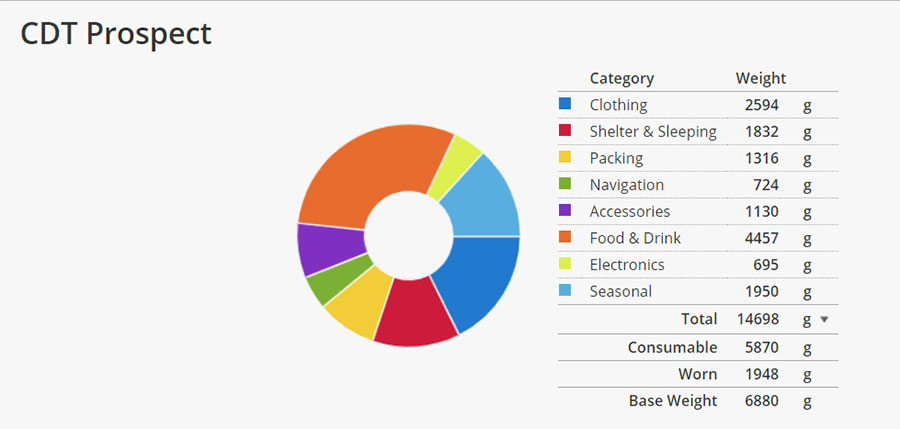
I will hike the trail with the same gear, start to finish1. I did this also on the PCT. This is testimony and a test to the versatility of a well crafted kit that must work in a wide variety of environments as well as through the seasons. It may be a stretch at times but it will work. There may be seldom used items in some sections but they’ll be too few to make it worth it to adjust back and forth.
This is the preliminary gear list in Lighterpack.com or a downloadable Excel format. The final list won’t change much. There is no such concept as “seasonal” in the listing tool so I have stated such stuff (axe, crampons and snowshoes) as consumables so they don’t impact the global base weight.
Previous steps
I’ve been on the Continental Divide before, very inadvertently in my first visit to North America when I was hiking across Southwest Yellowstone, then more in earnest when I thru-hiked the Colorado Trail with which the CDT shares tread for many miles. I hold great memories of those route sections on the divide and I dearly remember that point where my trip took me away from it thinking someday I’d be back to that same point and I’d take the other way.

I’ve been on the CDT before. Colorado Trail, 2008
Meaning
Thru-hiking multi-month is one of the best, most meaningful and committed things I’ve ever done. I had never felt so connected to myself in a time continuum, never ever had such a powerful feeling about being where I wanted to be, doing what I wanted to do, so free of regrets, so true to myself.
I’ll be leaving things behind, I’ll miss people and stuff. Together with that I’ll be at my happiest and healthiest. Then I’ll see how I feel when I come back.
 RSS – Posts
Say what you want