

Maybe it’s that I planned for this trip in a bit of a rush, maybe it was just bad luck, maybe a sign of the times but I had several cases of gear/strategy failure, something I’m not used to and makes for some worthy comment. These below are the main offenders:
Waterproof top
ZPacks CloudCover
This is an old item, no longer available, built with plain DCF. It is not breathable and it doesn’t mean to be. I find this an interesting idea, currently unfashionable, if it ever was, with some potential to work well in some circumstances. It is a jacket with full front zip, pit zips and a hood with cord-lock and visor, i.e. a full jacket. No other extras though. One key feature is it weights 83 gr. I’ve had this jacket since around 2011 and I had only taken it with me on one multi-week trip where it didn’t rain much.
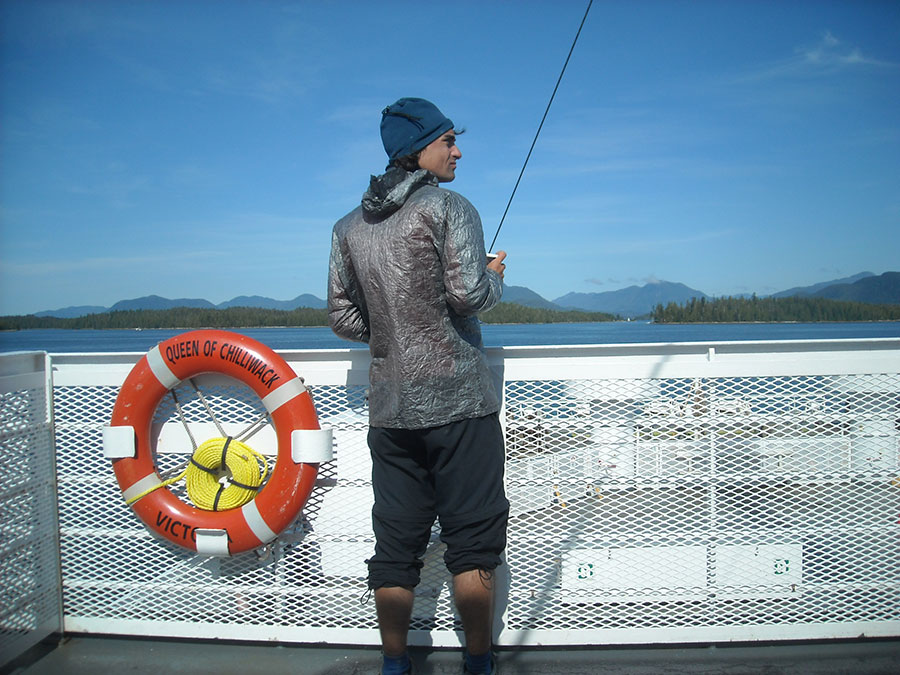
British Columbia, 2012
For the CDT trip I was carrying waterproof pants too.
I always pictured the Divide as a mostly dry place in the summer, never mind the afternoon storms whose worst I’d hope to avoid by the southbound hiking window. I had it clear I’d need the waterproofs but I expected the use would be occasional, the jacket would be packed most of the time and this particular one wouldn’t be weighting me down. The theory seemed solid.
By day 2 the weather got stormy even though the rain got me in camp. Day 2 is rather early on a 5 month trip. It rained again early morning on day 3 and by early afternoon on that same day I got a big dump followed by longer periods of sustained rain. The CloudCover leaked badly at the seams, which is a very bad thing to happen in a waterproof jacket. I could particularly feel the cold embrace of water leaking through the neck seam. After a couple hours hiking in moderate rain, I was soaked. Above anything else, I felt vulnerable and out of control.
At the end of that day 3, I arrived in Many Glacier, a summer outpost in Glacier National Park that would be my first resupply stop in the trip. By then I had it clear I wanted to get rid of the CloudCover and change it for something I would really trust. Many Glacier has only basic facilities, among them a touristy store where I found a Frogg Toggs poncho. I grabbed it, made it my transitional item towards rainy weather comfort and I immediately felt better.
The rest of the rain gear story on this trip is about using the poncho throughout Northern Montana, then the rain top of my current dreams. Many Glacier was a brief stop with no connectivity so I waited until 4 days later in East Glacier, a proper town where I got rid of the CloudCover through the mail and contacted home to ask for a substitute that I met at the Lima, MT post office. I was a happy, mostly dry hiker from then on.
The story of the failure has several aspects, most my own fault.
- The weather was wetter than expected
This wouldn’t necessarily invalidate the non-breathable CloudCover but it makes its use trickier. I’m actually not sure about non-breathable waterproofs. A mostly dry environment would be a good chance to try but this wasn’t the case on the Divide in 2019. It was more stormy than actually wet but more than enough to make me uncomfortable and my life on the trail turned much better after I got the jacket I knew I could trust and I was happy to carry it even if it was more than 3 times the weight.
- Seam sealing had degraded (and I didn’t check beforehand)
The CloudCover is sewn and it came unsealed. I used diluted silicone for a seam-sealing job I had successfully done many times on silnylon but only once on DCF, first time on a clothing item. It had worked well in the past but upon inspection at present I can see the silicone unevenly distributed in darkened blobs that had lost elasticity, quite likely not covering the seam properly. It’s the first time I experience such thing and I don’t know if it’s specific to DCF.

Silicone goo over seam
DCF can be successfully bonded and sewing is certainly not the state of the art. Bonding would spare the sealing issue completely. Sewing DCF is probably a legacy strategy and I’d guess the same garment, made today, would be bonded. My CloudCover is still in good shape so I plan to re-seal and keep using it but I’m currently not too eager to take it with me on a major trip.
Water filter(s)
Sawyer Mini, Katadyn BeFree & Lifestraw Flex
I started the trip with with the Sawyer Mini, which I’d had for a long time but had never used much. Here I made a big mistake, taking the good working of the mostly still unused filter for granted and not trying it before departure. The first time I tried to use it on the trail, the flow was almost nil, no matter how much pressure I used. I hadn’t taken the backflushing syringe with me in a rather incompetent move given my relative inexperience with the filter.
I wasn’t too worried, just mildly pissed off at such an early failure of plans. The far north of the CDT is abundant in good quality water and I was also carrying my standard set of backup pills. I knew I’d need a filter sometime though so I kept an eye on town stores. 7 days into the trip, I hit East Glacier, a small town with no proper outfitter but a small outfitting corner in the hiker-friendly local bakery. That’s right, the baker sells backpacking stuff and there was a Katadyn BeFree unit on the shelves. It was this much by chance that the BeFree became my filter device for the rest of the trip.
I put the Sawyer on the mail and resumed trip happy with my new filter but the story doesn’t end here. The BeFree was with me all the way to the southern terminus but not without issues. By Central Montana, the squeeze bottle started leaking at the seam, a delamination issue that turned hopeless. I tried some powerful glue that didn’t work and returned to the town store checking with my highest hopes set in Dubois, WY where I met the first proper hiking store of the trip. Unfortunately, they weren’t carrying the BeFree so I went with yet another brand, another model, this time a Lifestraw Flex which uses the same hollow-fiber technology.
The Flex was a big disappointment. The flow was never satisfactory, it needed a lot of effort and even then it was despairingly slow. I hated using it from the very beginning and set myself on town store watch mode again.
I hiked the whole of Wyoming with the Lifestraw while I built my biceps during operation. It wasn’t until Northern Colorado that I could find another replacement in Steamboat Springs, a sizeable, touristy town with several mountain stores. There were Sawyers and there was the BeFree and I went with the latter, allegedly putting an end to my water filtering history of failure.
Well, not fully. The BeFree worked fine but when it started clogging it was difficult to recover. I’d follow instructions for cleaning, which is easy to do provided you have access to clean water (I’d do it in town) and needs no additional tools but the effectiveness of the cleaning proved limited. The flow would improve some but it was a short lived recovery and it’d get progressively worse.
I alternated the two filter elements I had, keeping one on the bounce box, eventually taking both with me throughout New Mexico and trying my best to clean them in town. By the end of the trip, both filter elements were painfully slow. Biceps building again.
The second squeeze bottle didn’t have any seam failure but it did develop a minor puncture that was easy to plug with the hand while in use. I never came to like the Katadyn squeeze bottles.
A word about filter cleaning
Once home, I applied the backflushing syringe to both the Sawyer Mini and the LifeStraw Flex. Both improved. The Mini was still painfully slow but at least it became workable. The Flex spouted some dark matter and turned to an acceptable flow. It’s a relatively heavy unit though compared to the others. I plan to stay with the BeFree and possibly get the compatible CNOC container so I can get rid of the Katadyn squeeze bottle.
Pic storage backup
On the cloud
I hired some room in a cloud provider and planned to upload every once in a while whenever I hit town with enough time and could find a computer, commonly available in public libraries and some lodging establishments. It would take a bit of dedication because unlike at home you can’t just leave the task going and go do something else but it shouldn’t be too bad. You couldn’t go lighter than this and your backup would be ideally located somewhere different than your own pack.
The idea failed dramatically due to the limited bandwidth. I was shooting RAW producing 20 MB files. It would typically take several minutes to upload a single pic. Such was the situation on a test run I did in a Northern Montana town before I started hiking, still wondering if that’d be the case anywhere else. The next try happened after one month on the trail when I already had nearly 1000 pics and the upload time quote was simply ridiculous.
I tried one further time while in Montana and another in Wyoming in case bandwidth limitations were local. Maybe they were but too common along the Divide. The first time I hit a town big enough to hold a Walmart, I bought an external drive.

Western Digital, should be at home in the Rockies
I should probably have ordered the drive online for more modern tech and less weight/bulk but the difference in these latter aspects wouldn’t have been dramatic. The drive I got worked well. I could have mailed it ahead of me to avoid carrying it and having the backup copy with me in the pack but it felt too much complexity for little gain.
The bandwidth issue may obviously change in the future. As it was in 2019, the cloud backup was not viable.
Cook bag & Cozy
Not used
No gear failure here but wrong strategy as the cook bag and its matching cozy were not used at all and I eventually put them on the mail.
The idea about cooking in a bag is that the pot is needed just to heat the water so it can be smaller than what you’d need to also hold the food. Then my 850 ml pot is big enough for compact stuff like cous-cous, noodles or rice so as long as I can find any of those I won’t need the bag. I wouldn’t like a pot any smaller, I find the size and shape a great compromise.
On the CDT town stores, dehydrated rice was fairly common and noodles were almost everywhere. It never happened that I needed to carry food that wouldn’t fit in the pot for a generous enough ration and I was always happy with my food choices. I was happy also about getting rid of the bag & cozy, no matter how little weight and bulk were involved.
Cell service
AT&T SIM & CrossCall Smartphone
My Smartphone for this trip, a CrossCall Trekker M1 Core, has dual SIM slots so my plan was to keep my home SIM and get a local SIM for use anytime I’d need cell service. I went with a GSM operator, namely AT&T so it was supposed to work straight away.
It didn’t. Upon further research, it turned out GSM can travel over different frequency pairs (I guess an uplink and a downlink) and none of those in use by AT&T matched any in the set my device could handle. At least, not in Northern Montana. It was allegedly for this same reason that I didn’t have roaming on my home SIM either. This may sound odd when traveling to such country as the USA, almost 1/4 century into the 21st but I was completely off-line unless I could get WiFi.
I was told this could change further south, the same provider could use different frequencies within the 3G/4G standard and there might be a match with the ones my device handles. This actually happened at least in some areas in Colorado.
I could have traveled phone-less, I’ve done that in the past but at least there were public telephones back then. Cell service is a resource that will come handy sooner or later and I didn’t fancy going without. I highly valued being as prepared for the trip as possible and I didn’t want to start with a handicap, albeit a non-hiking related one. It was unlikely that I could find a provider with matching frequencies for my smartphone and I didn’t want to spend time finding out anyway so I went the quick way and bought the most basic, cheapest phone I could find on the spot, i.e. the local AT&T shop in a mid-size, Northern Montana town. The end result is I hiked the CDT with two smartphones on my back/pocket.

The clone wars 2019
This hurt emotionally more than it did physically. Technology is here to help but sometimes it goes the opposite way around and makes things more complicated than they should be.
A word about cell providers in the USA
Among the big players, Verizon is said to have the better coverage in the countryside, whatever “countryside” means along the Divide. Verizon uses CDMA though and it’s bound to be incompatible with a European device using GSM, or that’s the common understanding. That’s why I went with AT&T which uses GSM. AT&T had no coverage at all every time I tried while in the mountains and sometimes not even in small, remote mountain towns. It was better than nothing but I wouldn’t recommend it for a trip on the CDT, nevermind the frequencies issue commented above.
I heard of at least one European hiker who plugged a Verizon SIM in his home smartphone et voilá, seamless working so maybe the GSM/CDMA thing does not apply anymore or there’s something I’m terribly missing.
Effective gear list
As the closing bit for these gear review series, this is what I can safely consider as the actual gear list that took me along the Continental Divide Trail. My Base Weight turned to just above 7.5 kg.
 RSS – Posts
Dave Sailer
Maybe you can find some useful information with these folks, if you ever need to get back to the U.S.: https://www.rvmobileinternet.com/
And…This has been a great series of posts. I like the way you think about things.
Viajarapie
Thanks for the link and the comment, cheers!
grizzlegear
How did the Rab gloves work out for you?
Viajarapie
I didn’t use them much, just early morning some days in Southern Colorado and New Mexico. They were all I needed for those freezing mornings and while they were light enough to be worthy of carrying all the way, I wouldn’t like to be without gloves in the mountains anytime. I was happy with them and so far they’ve become my default gloves for general, long distance backpacking.
I commented briefly on them on a different entry about the CDT gear.
Ulla Widqvist
I had the same problem with my phone (Swedish) in 2018, when I was going on a section hike of the NCT in Michigan. I first tried Verizon. The people at the shop couldn’t understand why it didn’t work, so I gave up on them. I then got an AT&T sim, but it turned out it hardly ever worked, only in bigger towns. So for a longer hike I would do what you did, get a cheap phone, from Verizon.
Viajarapie
The problem then is that you need to carry 2 devices, which sucks big time. That or carrying no phone from home and taking the time to download everything you’d need on the one you buy at destination, which doesn’t feel great given that nowadays we tend to carry half of your life in the smartphone.
Next time I need to get a new phone at home, I’ll consider its potential to work in North America in the purchasing criteria even though it seems strangely difficult to find out for sure, retailers don’t seem to have that information. Damn technology 🙂