
Whatever I considered worth mentioning about the gear items and techniques I used in Norway in 2023 goes here.
Shelter – Locus Gear Khufu
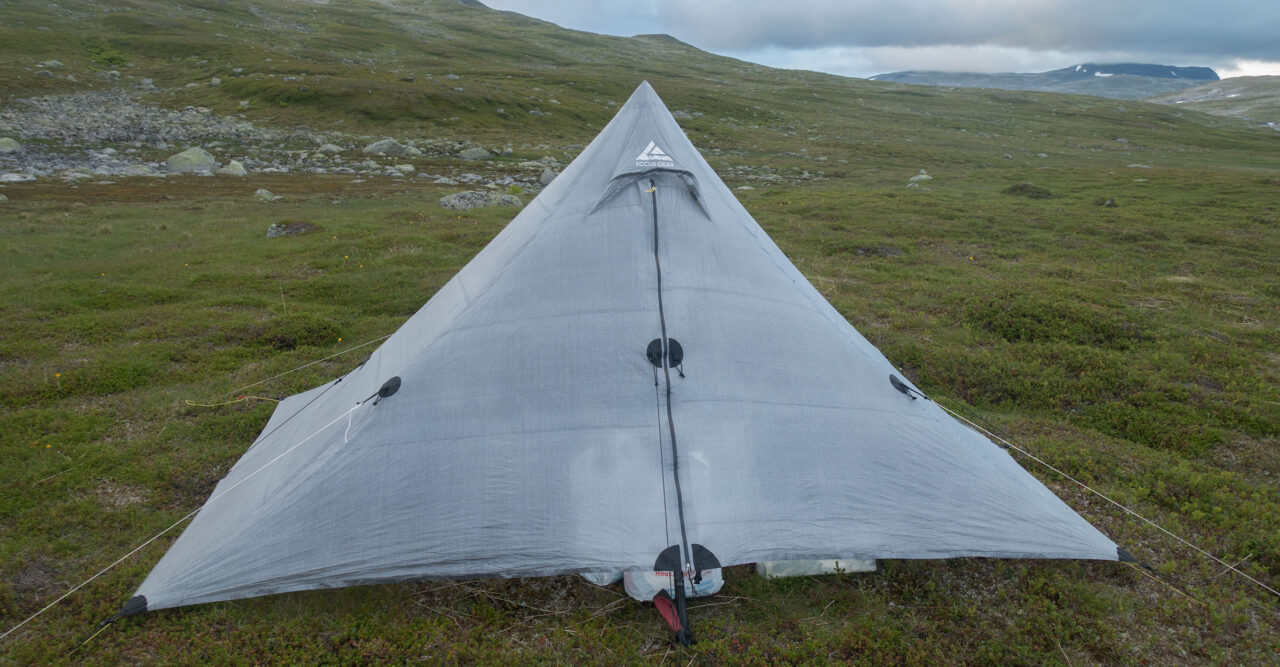
The Khufu is a one person, trekking pole supported, modular pyramid tent in DCF fabric. On this trip, I used the 2/3 mesh inner and the inverted-V pole extender for a two-pole, A-frame support.

The Locus Gear Khufu mid
Wind performance
I routinely used all staking points, 12 total, due to the mostly exposed locations but I fortunately never went through strong wind in camp so, unfortunately, cannot report anything new in this regard. The Khufu feels solid but I’ll need to wait for a tougher test.

Front view, fully staked down
Rain performance
I went through heavy rain and the tent handled it very well. The one thing that stood out as a major improvement over my previous default shelter, a MLD Silnylon Trailstar, was that the Khufu kept a drier environment inside overall. I had condensation but no misting, which I had often found as an outstanding problem with the Trailstar.
Most likely factors are the steeper walls and the use of an inner, even if its walls were mesh. I don’t know if the DCF fabric would make a difference over silnylon in waterproofness or condensation in practical terms.
I remember the wet conditions I often went through inside the Trailstar and how much of a problem that can be in a wet place like Norway together with my using a thin, summer season, down sleeping bag whose insulation can get compromised. The Khufu was significantly better in this regard. It still is my default shelter for the long distance.

Short side view
Waterproof top – Houdini The Shelter Anorak
I’d remember how vulnerable I had felt in the past in the Norwegian rainy weather in my default lightweight waterproofs and I had it clear I needed an upgrade so I got my first 3 Layer top in decades, hoping to up my game. I’m not sure how much it worked.
The Shelter Anorak is a design I like, pullover style with a loose fit and long enough to cover well beyond my waist. It was virtually new at the beginning of the trip.

Houdini The Shelter Anorak
My reservations are with the waterproofness. I’d expect a 3 layer, new garment with a 20K column to be seriously waterproof. The one issue that stood out from first use was that drops would impregnate de face fabric and wouldn’t bed off. This was shocking, every non-waterproof, cheap wind jacket I’ve used had better face fabric water repellency than this anorak.
The membrane layer would obviously be the main barrier but the outer fabric non-repellency was a bad start.
In practical terms, when I took the anorak off after any serious rain, I had some wet spots in my base layer, mostly in the elbow areas but nothing dramatic. It certainly worked better than my previous lightweight items but it didn’t meet my expectations. As stated above, my experience with 3 layer waterproofs is limited and I acknowledge this may be what it is.
Waterproof trousers – Rab Downpour Eco
Same as with the top, I felt the conditions in Norway demanded an upgrade over the minimalist items I had been using for years while keeping conscious the bottoms are less critical than the top, particularly when this latter covers well below waist level. That said, I wanted to feel like I could be hiking under the rain for hours and not take a full soak for granted.
I didn’t want to go for anything very fancy or heavy, didn’t do any deep market research and went for a safe bet with a decent record. The Downpour Eco from Rab worked well and it was not overloaded with features. The only extra it includes is the bottom leg zip which offers the obvious ease for on and off as well as takes my only down point. Bottom of the leg zips are an obvious weak point with a potential for failure, which is what you get with zips when they have to mix with dirt and rubble:

The flap cover helped but it was not enough
I acknowledge rain pants are not meant to stay on continuously so such zip may still outlive the garment. On this particular instance, the pants were new at the beginning of the trip and the zip didn’t show signs of down wear by the end. I could go with a non-opening and accept taking shoes off and on every time. If the opening is included in the design, I’d say hook and loop would be more robust.
Waterproof double layering
The idea here was to carry a second waterproof top and layer it on top or below the anorak in long lasting or heavy rain. At the risk of excommunication from the lightweight faith, this is as far as I was ready to go to feel like I could face the Norwegian weather and be comfortable with it.
The logic goes like this: every waterproof I’ve ever worn has been overwhelmed sooner or later and I didn’t expect my new, 3 Layer anorak to be an exception, just maybe a later. By doubling the waterproof layering, I would expect not only to postpone the getting wet yet more but I’d also look for some kind of synergy or added value.
This was meant as an experiment more than a heavier but sure-hit strategy. Testing conditions would require sustained, heavy rain in a thru-hiking context, in other words, what works in a day hike with a day pack may not do when out for longer with a bigger load. I wondered if the double layering would prevent wetting out for longer than the theoretical added times of each layer but which were these, anyway? In the end, my expectation was to feel better protected and more resilient to hiking in wet conditions for an extended time and to have a rough impression about this being worth the additional weight.
I considered several options for the second waterproof and eventually went for a poncho for several reasons: a garment different from the anorak so there was some potential for synergies as both pieces had their particular strengths and weaknesses. Then, the poncho would go over the pack, covering it better than any pack cover would and easing ventilation, thus minimizing the risk of too much waterproofing creating very damp conditions from within. I chose a Frogg Toggs poncho I had lying around, which is rather fragile but fairly lightweight. Vegetation at torso height is usually not a big issue while hiking in Norway.
Other than the added weight, what could go wrong?
Several things did. Mostly implementation’s fault more than the idea’s.
Number one, and this is a silly one, putting a poncho on over a full pack was an exercise in frustration, ridiculously difficult for such an apparently simple task. It may be related with my own arm reach. To me, it would always take several tries. Not that I’d be in a hurry but you don’t want to be fiddling with the waterproofs wearing when it’s already raining. This was an issue already known to me from previous trials of a poncho for backpacking but this time the paper-like nature of the Frogg Toggs fabric only made it worse. It’s very lightweight and doesn’t slide well over other surfaces so it was extremely difficult to get it to fall naturally behind the pack when trying to wear it upside down. A nylon poncho would have faired much better.
Number two, the poncho I used was not big enough. Not so much of an issue length-wise, being an additional layer over a full size waterproof system (I was using trousers too), but most critically volume-wise, which links back to the consideration of the big volume of a full thru-hiking pack and brings me to the next and main issue.
Number three, the snaps providing the side closing for the poncho were not meant to stand to much pull forces. Together with the limited volume of the poncho, it made the snaps come undone frequently and too easily, leaving the sides exposed and, very often, the front and back of the poncho flying around, exposing pretty much everything they were expected to protect. I’d end up breathing softly and crossing fingers, there was little else I could do.
All these problems would reveal specially when the pack was full. The whole thing was so unworkable that I ended up using the poncho as an oversized pack cover, giving up on the double layering and feeling silly about my poor choices.

My pack, impersonating ET
When food volume went down, I could use the poncho as it was meant to and, if pack volume was low enough, the whole scheme worked quite well but the limited test time didn’t allow for clear conclusions as to the validity of the idea.

Ghost selfie in heavy waterproofs
Next time I travel in Norway or other similarly wet place, I plan to try this idea again but I’ll definitely change the Frogg Toggs poncho for a woven fabric one that can be closed securely along the sides and has ample room to hold the pack at full load. Alternatively, I might go for a torso-only double barrier and leave the pack out of the system, a poncho-over-pack is always tricky when the latter is thru-hiking size.
Trousers – Ternua Ward PT
You may not know the brand/model but it’s a fairly common design across well known makers. I had reservations about its suitability for summer thru-hiking in Norway, which is the core of these comments below.
These pants are soft-shell, bi-component, 4 way stretch and black in color. Despite my general dislike for stretch fabric in trousers, I liked these ones from the second I tried them at the store. They were very good quality in fabrics, patterning and making and they were the closest you could get to a rock-star look in hiking clothing. My reservations were about the combination of a fairly thick fabric, the black color and their standard, non-convertible design having the potential for being too warm for summer hiking. Even in Norway.
Stretch, bi-component fabric is also slower drying than single layer, thin nylon, which is what I had used just the previous summer, also in Norway, with success and not a single time feeling I was too cold or unprotected.
I liked the Ward PT model too much to not give it a try though. It had pretty much everything I like in important design elements like pockets and lower leg hem cord-locked elastics so I could easily bring them up above the calf.

No kidding about the rock stardom
They worked very well and felt great overall. Not once I felt them too warm. While the bi-component fabric certainly takes more time to dry than single-layers, it’s also more comfortable when wet.
The most important statement here is whether bi-components are best for the Norwegian summer. Unfortunately, I don’t have a clear conclusion. Maybe it’s actually fortunate in the sense that the legs are too forgiving for any reasonable choice to work well.
 RSS – Posts
Patrik Björkkvist
Any updates on wind performance of the tent ?
Viajarapie
Indeed, yes. I literally just came back from another visit to Norway with the Khufu and this time the weather was consistently breezy. I needed to look for a somewhat sheltered spot every of the 7 nights I camped.
I expect to do a gear report for this latter trip where I’ll comment about the Khufu wind performance. In short: it’s good to very good, with the necessary cautionary mention: it’s a largely unframed shelter and its wind performance depends entirely on a good pitch. That said, with the proper tension and using all staking points available (4 corners, 4 mid-panel, 4 mid-height ridge), it stood beautifully. It never went through anything stronger than maybe 40 km/h gusts (not sustained) but it stood that fine. To me, this qualifies as good to very good. Surely a fully/heavily framed dome or tunnel will be more solid but such shelters are in a different league.