"Viajar a pie" is Spanish for "Travelling on foot"

Category: Europe Page 1 of 2

St. Moritz to Zermatt

WhereSwitzerland/Italy
WhenSeptember
Distance425 km / 264 miles
Length15 days

The Matterhorn/Cervino

This trip was only my third long distance hike in the Alps. At this stage, I have only scratched the surface of such a big and diverse mountain range. It can only be a good thing in the sense that there’s a lifetime of meaningful routes to follow.

In late summer 2024, I visited the border region between Switzerland and Italy for a multi-week, westbound hike between iconic spots St. Moritz and Zermatt. Lots of mountains in between and several lessons learnt along the way. I have now certainly broadened my alpine background.

See the menu to access all content for my trip in Swiss/Italian Alps.

St. Moritz-Zermatt, part 3: Tour de Monte Rosa

In late summer 2024, I hiked from St. Moritz to Zermatt along the Swiss/Italian Alps. This is a record of the final three days, when I walked the northern half of the Tour de Monte Rosa.

Tour de Monte Rosa

I can hear the wind howling from my bunk in Rifugio Oberto-Maroli and I may guess it’s rather unwelcoming outside but what I didn’t expect is the wintery scene I found when I peaked out:

Winter’s coming

It had snowed lightly overnight, the fog had thickened and the freezing wind rounded up the winter feel. This was not what I’d have expected from a mostly favorable forecast that warned about cold temps but clear skies and no major events. It will be a hilltop condition with local cloud, I argue, but this alone may make me reconsider my plans.

In previous chapters, I’ve gone in depth about how much I cared for completing my trip by making it to Zermatt and how hard I had worked to make it possible. At my location in Monte Moro and with three hiking days left, distance wise, Zermatt was well within reach. Terrain wise, I’d still need a reasonably good weather window. My idea was to hike the southern half of the Tour de Monte Rosa and reach Zermatt by going across the Alpine Divide on the last day via 3295 high Theodul pass.

I never liked the idea of going through the highest and, in a way, most challenging spot on the trip just hours before finishing with travel schedules to go back home immediately after but it should be fine in good weather conditions. Otherwise, there’d be some risk of getting seriously stuck, I wouldn’t foresee any alternative to Theodul pass that would take me to Zurich on time for my flight.

The good news being the best alternative would take off right from where I was at the time. Instead of going clockwise on the southern half of the Tour de Monte Rosa, I could cross back into Switzerland in Monte Moro and reach Zermatt over the northern half of the loop with no need to cross any other high pass. My lovely hut warden actually recommends this option while he stuffs the table for the best hut breakfast on the trip. By a long shot.

Nothing was spared

It’s roughly the same distance, shorter only by a few km, and allegedly more scenic but it’s not the logical way to finish the hike as I had pictured it so it’s with a bit of a heavy heart that I decide to cross back into Switzerland and down the Saastal to get to Zermatt while keeping on the right side of the mountains.

Leaving Oberto-Maroli

The plan update includes added difficulties in the initial climb back up to the pass and down the other side. The conditions are similar to those in the previous evening but colder, with lower visibility and, worst of all, slippery rock. The metal stairs felt a bit overkill the day before but they’re a life-saver with the rock turned into a slippery mess.

Retracing steps

It’s a relief the wind is not too strong at the pass so it’s very manageable. It’s super slippery all over the place so I need to keep calm and force myself to make it slow and careful. Route finding is luckily not an issue with the good quality permanent signing plus the temporary flagging in place for a race event.

Route finding made easy

It takes me about an hour to get off the rock, the snow and the fog, pretty much all at the same time. It’s great to be able to walk on dry dirt again.

Back to normal walking

Once I’m back into standard hiking, it doesn’t take long to reach grass and the Mattmark, the dammed glacial lake at the headwaters of the Saastal. Water color is the usual milky in a size I’m not used to.

Mattmark

On the other end of the Mattmark and from the vantage point of the dam, I get a first view of the Saastal floor all the way to the first village Saas-Almagell while clearings unexpectedly open in the thick clouds.

The Saastal

Down from the dam, the TMR1 route parallels the road through some nice woods, then takes the road itself for a less glamorous, still scenic approach and traverse of Saas-Almagell. The town is modern-touristy and very quiet in the September off-season.

Up from the main valley floor on a side branch, the TMR visits most famous, oddly named Saas-Fee village, tucked under sizeable Feegletscher ice and 4K+ peaks that I can’t see because the clouds have thickened again.

Saas-Fee

Saas-Fee is off-season too but still busy with hikers, urban visitors and ski season prep works. This latter suits the cold weather.

Here I rejoin Route 6, the Alpenpässe-Weg that I had been following for the first week of the trip, now again as it shares tread with the TMR along the flanks of the Saastal. The clouds break again overhead while still clinging to the peaks.

I was hiking on the other side of that crest the day before

The TMR stays around the tree line while traversing the often steep terrain in the west flank of the main valley but the trail is consistently good, as it’d have to be expected from such a popular route.

Trail engineering on the TMR

I’ll be hiking north to the confluence of Saas and Mattertal but that particular spot will be for the following day. There aren’t many obvious places to pitch a tent in the TMR and I have identified this one on the map that nicely meets a relatively early stop compared to the trip’s standards so far. I’m camped by 7:30 PM and I can see some dusk colors while I have my dinner.

Camp before dusk

It’s very cold in the morning. No surprise about that but it still was a bit of a shock to see the thermometer go down into the double digits negative.

9 AM at 2100 m high

I honestly don’t think it was that cold and that the device was off for some reason but then I went through the frozen streams on the slopes showing some thick ice that had probably built overnight. Double or single digits, it certainly was cold.

Frozen over streams

You can feel the cold air and see the condensation clouds around the tops and I feel glad I don’t face any high passes anymore. The sky is mostly clear though and the early morning light is beautiful. Climbing up from my sheltered camp, I get a view of what was above.

Balfrin Ice

The TMR is and endless sidehill, often across steep terrain. The trail is drawn somewhere there:

Typical TMR terrain

By late morning, I get to the the confluence of the Saastal and the Mattertal. Here I turn south for the final stretch of my trip.

The Mattertal at last

There’s been new snow in the high areas and thick clouds sit around the peaks consistently. It’s an expected outcome of the cold air mass and once again I feel glad I don’t need to climb high anymore. I can feel Zermatt within reach.

Getting there

The TMR section above the Mattertal goes by the name Europaweg. It follows the same pattern as the section in the Saastal but with a trail so heavily engineered that sometimes it doesn’t feel like a trail anymore.

Walkways, handrails, stairs and ladders

I might have thought it was a one-off to save a tricky section with no obvious alternative but there were several episodes of such mess. At some point, I felt like if all this was necessary maybe this route shouldn’t be here at all.

As long as I’m hiking it, I can certainly appreciate the scenic quality, starting with the spectacular views to the glaciers on the opposite side of the valley.

Bisgletscher lower end

There’s also the amazingly beautiful larch trees, whose upper reaches the route skirts.

Mountain larch

And the ice formations, which are not melting a bit throughout the day.

Ice on grass

Shortly before day’s end, I get an initial view of the Mattertal headwaters with Zermatt town party visible down on the valley and the backdrop of the Alpine Divide. Somewhere there in the lowest section of the crest is Theodul pass, which I should have been crossing from the south.

Mattertal headwaters

Coming up is Europahutte, where I had planned to stay for the night, given the cold weather and the limited camping options in the Europaweg. I had phoned the day before to find out whether they were still open as all the summer infrastructure seemed to be about to close. I actually found room by a stretch.

Europahutte

I was not aware this trail section had nothing to do with pretty much anything I had hiked during the two previous weeks, that I had spent mostly on my own and where I could just show up in huts and expect to find room. This area appears to be extremely popular and even this late in the season the hut is full.

It’s Friday night and I’m told it’s the final weekend for the season anyway.

Home for the final night

And then it’s the final day of the hiking with just over 22 km over the TMR to reach trip’s end in Zermatt. It’s day 15. For the first time since I started hiking in St. Moritz, I feel relaxed.

Just south of the Europahutte, there’s another straight line in the map, not as long as the 3.5 km tunnel a few days back but just as unnatural looking in the cartography. It’s the Charles Kuonen suspension bridge, allegedly the longest of its kind in the world with a nearly 500 m span.

Length: 494 m. Height: 85 m. Elevation: 2080 m above sea level

The bridge saves a wide chute of a very hikeable angle but too prone to rockfall, deemed unsafe enough to justify the mastodon infrastructure. While I may appreciate the safety approach, I have to wonder about the practicality of a recreational trail if the location is so discouraging.

The weather keeps the previous days’ patterns, cloudy and cold. The morning overcast provides easier light conditions for pics than those in the previous evening and I get this great view of the Bisgletscher:

Bisgletscher and Weisshorn

Further up the valley, the dominating view shifts to the Hohlichtgletscher and the Zinalrothorn.

More ice

The slopes are not particularly steep but for some reason the whole are seems prone to rockfall. Signs warn about the potential and there are several sections requesting hikers to pay attention and avoid stopping. There are also long stretches where the trail is brimmed or even tunneled.

Rockfall protections

It doesn’t feel like a good place for a hiking trail.

It’s a cold and overcast mid-September afternoon when I finally get to see live the iconic profile of the Matterhorn/Cervino:

Zermatt and the Matterhorn

Matterhorn / Cervino

It’s its prominence and relative isolation from other high peaks that make it so outstanding. Rather selfishly, I think of all the hard work it took me to get to this view.

As a testament to that, this is the first day on the trip where I take time for some selfies. So far I could do nothing but hike.

People ruining paintings

While the Matterhorn is the obvious main character, the trail offers views to several other mountains. It’s an incredibly scenic place.

Gabelhorn and its glaciers

Unexpectedly, the clouds break and the whole vibe changes dramatically. I can take the gloves off, hike in my shirt again and get a different light on the big horn.

Blue sky

All that’s left at this point is the climb down to Zermatt, where I get in late afternoon. The town is a shock. There seems to be no off-season in this place or I don’t want to think how this is in prime time.

Downtown Zermatt

The campground is on the opposite end of town and on the opposite end of the glamour but it’s probably the only place to stay whose cost is not in the three figures. It’s very basic but otherwise fine.

Zermatt campground

It was difficult to find a place for dinner but I persevered. Not for the food itself but the symbolism. I had earned my beans.

St. Moritz-Zermatt, part 2: Grande Traversata delle Alpi

In late summer 2024, I hiked from St. Moritz to Zermatt along the Swiss/Italian Alps. This is a record of the second week, when I walked along a section of the Grande Traversata delle Alpi.

Grande Traversatta delle Alpi

It’s day 8 and I wake up to dark skies again. I can’t even remember what the weather forecast was at the time but it’d look like it wouldn’t matter, the cloud seemed to always be there. As I break camp, it’s got foggy around.

Yet another cloudy morning

It’s a few miles along the hillside on a gravel, wide track that connects a series of alp settings before the junction where I’ll leave the Alpenpässe-Weg that I’ve been following for a week. On the way, what looks like an avalanche path. You can only try to guess the power of it by the downed trees:

Avalanche path

The junction in Alpe di Cristallina is a main milestone, I have been following the Alpenpässe-Weg, Number 6 in the Swiss system, for a week. At the time of planning, it’d look like entering less interesting terrain for a good while so I drew my route over different trails, aiming for the high areas without leaving the trail network. This is where I leave the Alpenpässe-Weg.

Leaving the Alpenpässe-Weg

I leave the hillside walk to climb into the mountains and into the fog. The trail is still easy to follow and the signaling is the usual good.

Good trail, good signaling, good fog

The fog thickens as I climb to Passo di Cristallina, which is not much higher than the several grassy passes I had gone through in previous days but this one is on rocky terrain from a good while below. There’s a hut at the very pass. In the present conditions, I have it very clear that lunch inside will be much nicer.

Capanna Cristallina

I was climbing in my long sleeve shirt but when I leave the hut I need to really layer up, it’s dark, cold and downhill over wet rock, still on a good trail though.

Down from Passo di Cristallina

The fog adds to the drama but it’s a bit of a pity to miss the views for a first time visit to the area. Once off the pass area, it gets quieter and less cold while progress is on the slow side on a wet, rocky downhill.

Halfway through the descent, the trail meets briefly with a gravel road, part of the hydro schemes in the area, that I could keep following for much easier progress but I decide to stick to the trail. The bonus is coffee and cake in Capanna Basodino that the road would have missed. Given the chance, it’s a good move to take a break inside when the outside would quickly lead to being uncomfortably cold.

Capanna Basodino

Up from the hut, it’s the final miles in Switzerland for the time being. After an initial steep climb in the fog, I get to an imposing high valley that leads to beautifully named Bocchetta di Val Maggia and the border with Italy.

Bocchetta di Val Maggia

Switzerland | Italia

It’s on and off the fog down the pass with some old snow that’s probably easier walking than the wet rock.

Old snow

The rock world leads to a high pasture area with grazing cows, shepherds’ huts farther down, then hydro schemes and a CAI2 hut that I’d had happily stayed in but it’s not raining so I make the final descent to the main valley where I meet a road and Riale village.

Riale, 1729 high

There’s a beautiful looking alpine lodge right by the trail and it’s one of those days when it’s difficult to keep going pass that. I’d almost wish it’d start raining so I’d have the perfect excuse to be inside but it doesn’t.

I have just enough daylight, so to speak, left to climb out of the valley floor and find a flat bench to pitch the mid. I have dinner with views over the valley.

Comfy camp

Day 9 is overcast again and the forecast calls for sustained, heavy rain after mid-morning. It looks like a bad day to be outside, less so sleep outside after a full soak so I see my options. There’s a pass upcoming, then I’ll go down to a hut. Then it’s up again another pass followed by a long way down to a road-accessible, recreational area where there’s another hut. I set my beacon to the latter and resume the low mood hiking, heading up Passo Nefelgiu.

Looking back down Vallone di Nefelgiu

It’s a short way down Passo Nefelgiu to dammed Lago Vannino, soon visible down the trail.

Lago Vannino

It starts raining literally 200 m before I go by Rifugio Margaroli, found by the dam and above the lake shore and I have it clear: go inside and ponder my options while I have some coffee and cake.

Rifugio Margaroli

In between a challenging and a conservative approach, my initial plan for the day was to go past Margaroli, climb the following pass and safely come down to Alpe Devero where I’d find another hut to sit my wet bones for the night. It’d be only 13 km more, it shouldn’t be too tough but when I look outside to the now heavy rain, getting out feels like the worst of ideas. The hut warden confirms it should be raining for the whole day.

I change my mind several times as I keep an eye on the degree of darkness outside. On the one hand, staying put would be disastrous for my overall average and my goal of reaching Zermatt at the end of the trip. On the other hand, I still have it recent how tough it was to keep going in a similar situation a few days before and I tell myself I don’t want to go through that again.

It’s only mid morning as wet hikers start pouring into the hut. I tell the wardens I’ll stay for the night.

Main room by the evening in Margaroli, fireplace on and lots of wet clothing around

It did rain solid for the rest of the day. It’s difficult to say how tough it’d have been to keep going to the next hut and whether staying was a good decision. I felt bad about it but at some early point I intendedly stopped mulling over it. No point.

It was a busy day in Rifugio Margaroli with a continuous trickle of wet hikers coming in. I had some time to outline plans for the rest of the trip, relax and enjoy a hefty dinner. Good times.

The next morning wasn’t rainy and the forecast said the worst of the storm had passed but the vibe was still far from quiet. There were spells of light but the sky was often overcast. On the way to 2599 high Scatta Minoia, it got windy and surprisingly cold. Nice view back to Lago Vannino and the Margaroli hut with the distance somewhat blurring the sight of the hydro schemes.

Lago Vannino from the south

Scatta Minoia is a high enough pass to be mostly rock underfoot. It feels wintry across the saddle with thick, low cloud and a biting wind that makes me welcome the emergency hut at the pass. It’s been just one and a half hour from departure and I’m not tired neither hungry yet but I get inside to get away from the wind while I layer up. The hut is in good condition but the concrete walls don’t make for much warmth.

Builders wanted to make sure you don’t miss this one in low vis conditions

It rains again as I come down the pass, only a shower so nobody gets too relaxed. The weather stays unsettled. On the other hand, the scenery is very nice with a lake basin and alpine meadowland as I approach the tree line.

There were sunny spells. This is not one of them

Further down the valley, the route enters the sheltering woods and this is peace for the hiker tired of fighting. Lago di Devero is the unmistakable reference.

Lago di Devero

Past the lake, there’s Alpe Devero, a wide, roughly circular and fully flat meadowland flanked by high hills all around. It looks like a former lake but if it ever was, it’s long gone. The place is now at the end of a mountain road and it’s partially urbanized in stone and wood mountain style. It’s a beautiful place despite all the modern housing. Together with a lighter cloud that lets some sun through, it quite lifts my spirits.

Alpe Devero

Up from Alpe Devero, the route climbs onto an oddly-oriented headwater area draining northeast between the main alpine divide and a secondary ridge. It’s a beautiful stretch, nicely sheltered alpine meadowland flanked by trees against the backdrop of high, rocky peaks. Grazing cattle enjoys the grass, I enjoy the hiking.

Alpe Buscagna

The route leads to Scatta d’Orogna, a pass into a roughly parallel valley that the trail will side-hill onto Passo di Valtendra, a major east-west notch.

Passo di Valtendra

Could cover had been thickening since the happy hour in Alpe Devero but the vibe was keeping overly quiet. Going across the pass was like entering a new dimension. All of a sudden, I meet darkness, low cloud and a cold wind. Ceasefire’s over. By the time I get down to the grass and trees, it starts raining.

Pian du Scricc

I wasn’t expecting this major rain event but I somehow don’t get too pissed off by it, maybe I’m getting used to but it surely helps knowing that there’s a hut I could use in upcoming Alpe Veglia.

I spend a good while hiding from the rain by the door of the Rifugio Citta di Arona considering options. Alpe Veglia is a beautiful place, a headwater plain with the backdrop of the 3K peaks of the alpine divide. It’s a couple of hours before dark, I’ve hiked 27 km and it’d make all the sense to go the easy way and stay in the hut. On the other hand, my schedule has got so tight after the previous day’s short journey that I really need to hike those two hours. Staying in the hut would literally mean saying goodbye to my goal of reaching Zermatt at the end of the trip. It was an exciting plan and I had been working hard to make it happen. Rain has eased. I decide to keep going.

Alpe Veglia

It’s all downhill from Alpe Veglia on a vehicle-worthy track that saves the major step to the valley floor across a steep hillside. The alp above should have been a hard reach for people and cattle before the track was built.

I try to make the most out of the decision to continue by jogging down the road with the slope in my favour. It’s just quad work but no high exertion. Not the first time I do this on this trip, neither the last. By the time I get to the first village in the valley, it’s raining again and I’m tempted to find accommodation in town but the place is touristy and pretty much dead in the off-season.

Once in populated areas, the issue is to find a quiet, hidden camp spot with the trail traversing a non-level hillside for ages but I spot a flattish area ahead in the map and it works out. Woodland campsite in the dark. Camp pic from the following morning.

Val Divedro woods

Keeping the goal within reach is motivating but also demanding. I need to keep working hard. I had been going through the maps before going to sleep and identified a potential for time saving in the upcoming stretch by changing slightly my route down to Varzo village. My original route takes trails on the hillside while the paved road runs parallel near the valley floor. It’s roughly the same distance but I could easily jog down the road for much faster progress. The road would be longer if I take all the switchbacks but the map shows short-cutting trails and I go for it. It’s 9 km from camp and I get to Varzo before 9 AM.

Varzo, Italy

Varzo will be, by a very long shot, the lowest point in the trip, just above 500 m high at the bridge over Torrente Diveria. It’s also my last planned resupply point and I top up for the final five days on the trail in one of the small local groceries.

Unglamorous but functional

Following the deepest point comes the longest climb, 1700 vertical meters in one go to 2235 high Passo di Variola in a 8 km stretch which makes it consistently steep. Getting out of the valley floor is the toughest part and I take it with patience. At about the 2000 m mark, I get one final view of the valley with the Varzo village sprawl on the side of the hill.

Val Divedro, 1500 m below

I had been too busy making miles and trying to save time out of every simple hiking-related task to take note of some important news that become outstanding the moment I’m back in the alpine: the weather is quiet and clear for the first time since forever. I won’t deny all the past fun but I welcome this break so much I can find no valid comparison in human language. It’s so good to be able to relax and plain enjoy the hiking.

Passo di Variola goes across a spur of the main range and I have this feeling that going across it leaves me in the same position, geographically. It leads to a long sidehill facing the Valle d’Ossola, whose floor is as low as 250 m. Whenever the topography allows, the view is remarkable.

Valle d’Ossola

In a progressive descent, the route enters some beautiful beech woods with that distinctive beech-woody atmosphere.

Nothing else filters the light as the beech trees

While keeping to the same sidehill, the trail starts climbing back up to the alpine. The sky remains clear but the quiet feels kind of over when the wind picks up and I can feel the cold. I climb vigorously, trying to strike a balance between exertion and wind chill so I can still hike in my shirt in that well-known, lost battle that you’re sometimes ridiculously happy to fight.

There’s this nice, level meadow below the trail, sheltered by the terrain and the last of the trees that’d be the paradigm perfect campsite in a thru-hiking context. There are some alpine lakes in their respective alpine bowls that I could reach before dark that’d be the perfect campsite in a mountaineering context. About mid-way between the two, there’s stuffed hut Rifugio Alpe Laghetto. I stop here to get water from the outside pipe.

With the sun gone and a cold, biting wind blowing, I take a few minutes to decide what I really want and eventually go for the high-treason thing again. I go inside.

Rifugio Alpe Laghetto

I may add the hut is lovely, of those small, cozy ones with only a handful of guests and a very relaxed atmosphere. I file it in the guilty pleasure folder.

The following morning, I show up for breakfast as soon as management allows, still dark outside. I have a big day ahead. By the time I’m ready to go, the sun’s out and it’s a brilliant, cold morning. The comfy night’s rest and calm weather help bring my spirits up and I feel actually excited for the day’s hiking for maybe the first time in the trip.

Up from the hut, the route keeps the sidehill for a few more miles before the next major pass. On the way, I go along the Laghi di Campo which would have indeed been a memorable place to spend the night.

Laghi di Campo

Passo di Pontimia brings me back into Switzerland, if only briefly, and the north-flowing valley below would look like it was my first contact with the Rhone watershed but a look to the map reveals otherwise, I’m still south of the main Alpine Divide marked by the big, glaciated peaks in front.

The main Alpine Divide across the Zwischbergental headwaters

It’s less than 5 trail km on this side before returning to Italy over Passo d’Andolla, visible in the previous pic as the second lowest point on the ridge to the left. A very scenic sidehill.

Pizzo d’Andolla in front, namesake pass on lower left

Passo d’Andolla is walkable on both sides despite the steep-walled, narrow ridge it traverses. It brings my route back to Italy.

Passo d’Andolla

The view ahead is very revealing of what comes next, I can see the whole of the headwaters area I’ll need to traverse all the way to the next pass, somewhere on the opposite side of the valley.

Andolla to Coronette

Reusing names, there’s Rifugio Andolla on the high valley floor. Getting down is straightforward. Signs warn about the potential difficulty of Passo di Coronette ahead, whose south side is a narrow corridor equipped with a handrail chain. Experts only, signs say. I’ll see if I can be considered an expert by Italian hiking standards.

What signs didn’t mention is the tough section in the approach to the pass where the route crosses valley sides. Rough trail and thick bush make it slow and I’m tempted to start counting the miles but it’s too early for that. There’s some tough stuff ahead and some nice light around as clouds build on the final push for the pass.

Multi-named spot on the way to Passo delle Coronette

The pass itself is just the access point to the corridor on the south side and it offers views ahead and down to dammed Lago di Camposecco.

Lago di Camposecco

With dry rock, the narrow couloir would be a fairly easy climb up. Going down and with a big pack is trickier and good care is due to avoid the extra volume in the back hitting the wall and throwing the down-climber off-balance. I make use of the chain for extra safety in selected spots.

Down from Passo delle Coronette

Once off the corridor, the fun is not yet over. A big boulder field down to the dam makes downhill progress necessarily slow and I start feeling a 30+ km day is gonna be a challenge but I’m well aware this is not the stretch to hurry it up.

Many boulders

It’s late afternoon by the time I get down to the lake with more than half of the day’s planned distance still ahead. The clouds have got thick with no gap for blue sky. I feel back from excitement to business-as-usual hard work.

Lago di Camposecco

The hydro schemes provide for some quick progress though, at least for a while. The mountain side is steep but there’s a flat platform across even the steepest of headlands, likely hiding some pipe.

Impromptu hiking trail

I’ve been skirting hillsides for days at this point and so it’ll remain until the next major pass where I’ll finally go across the main divide. Not knowing the area beforehand, I had taken notice of this weirdly straight section of trail as it appears on the maps and I could easily guess that was not your normal trail. It looked like a tunnel. A quick internet search confirmed it was indeed a tunnel. A nearly 3 km long one.

What was a tunnel doing in such a place, I did not know neither did I research. I did find out it had a light switch at both ends with a timer that should be enough to go through in normal conditions. The rest, I’d find out on the spot.

Signs are clear enough

The tunnel is part of the hydro schemes. It holds a big pipe with barely enough room to walk on its side. Head room was just enough for my 1.70 m but so tight I instinctively bent down slightly as I walked. Definitely not a place for the claustrophobic.

The tunnel

It was dark and wet in the tunnel. The ground was often flooded as much as ankle deep even though some sections had a metal grid underfoot that mostly stayed above water level but wet feet were unavoidable. Lighting made the way feel considerably better than I could have imagined without but don’t picture a seamless flood, lighting points were visible from each other but far enough to leave darkness in between. A powerful headlamp would have been much more welcome than the minimalist one I was carrying.

On the Camposecco end, where I entered, the light switch was several yards inside. I spent a few silly minutes looking for it closer to the entrance.

I made it through as quick as possible and was relieved when it was over. It wasn’t a nice experience.

Once out, I really welcome being back to the light even though the vibe is far from bright. The clouds have got thick, it starts raining and I feel glad I have hut options ahead. My goal for the day is actually Rifugio Oberto-Maroli, still two passes away. I’d need to make it at least that far if I wanted to keep Zermatt within reach. There’s only three more days ahead and I have no cushion.

I have barely stopped for the whole day but the journey has somehow turned into a race against time if I want to be across the last pass before darkness so I don’t waste a minute and go straight for the climb to Passo di Antigine.

Passo di Antigine south side

Also known as Ofentalpass if taken from the north. This is finally a way across the main Alpine Divide and into Switzerland. Over onto the north side, I look down on the Rhone watershed for the first time on the trip.

Saastal headwaters

I feel quite relieved that I’ve made a good time climbing the pass and I see I should be able to reach Oberto-Maroli before nighttime in normal hiking conditions but there’s no stopping. The route here goes down the Swiss side just enough to find favorable terrain around Pizzo di Antigine, then back up towards 2845 high Passo del Moro. It gets foggy and it gets late, not sure which one is the main factor in ensuing darkness and I’m glad the signaling is good in this area.

Passo del Moro climb

I reach the pass in low visibility conditions, back into Italy and the Po catchment area but I have no time for such considerations. Without being terrible, the conditions up there are tough, wet, windy and cold. It’s only a few minutes down to the top station of a series of ski lifts and the hut. I come down quick and the mist shifts briefly to reveal a rather desolate scene. More buildings than I’d probably like to see near a mountaintop but no signs of activity.

Metal steps down the pass

I’m glad I had phoned the previous night to make sure that Oberto-Maroli was honoring its name and it was actually open and stuffed because the whole place looks dead as it comes into view.

Rifugio Oberto-Maroli

It’s 8 PM in mid September and it wouldn’t be nice to find a closed door at 2800 m so I’m relieved when I eventually see some light across a window, the door opens to my push and I get into what feels like another dimension.

Such a contrast

I’ll be the only guest that night. The warden confirms the hut will be closing down for the season in short.

It’s been only 32 km but what a long 32 km. It’s taken me 12+ hours, out of which I’ve taken one only half hour break. At this point in a thru-hike where I could be eating all the time, I haven’t taken anything for more than 8 hours. There always was enough motivation for keeping on.

I don’t know if it was standard or a premium for being the one and only (guest) but I surely didn’t complain about the huge, three course dinner. The caretaker kept producing dishes and I got them all, to my own surprise. I finished even the bread basket. There must have been a big void in there.

This slideshow requires JavaScript.

At this point, I was three days and less than 80 km from target. I had made it possible. The weather forecast was not too bad, with a cold air mass installed in the region bringing low temps and general instability but no major rain expected. There was more hard work ahead but I felt like nothing could go wrong.

St. Moritz-Zermatt, part 1: Alpenpässe Weg

In late summer 2024, I hiked from St. Moritz to Zermatt along the Swiss/Italian Alps. This is a record of the first week, when I walked along the Alpenpässe-Weg route (not the whole of it)

Alpenpässe Weg

The early morning train ride from Zurich to St. Moritz is relaxing and scenic but I get increasingly restless as it gets close to destination. I need to start hiking and I do so from the train station, along the odd glamour of the luxury hotels and the occasional oversized limo and with a mandatory stop at an outdoor store to get a butane canister. Then I’m good to go.

St. Moritz

The well-signed route emerges from the woods onto grassy slopes riddled with ski infrastructure so I don’t have to go headlong into the wilderness.

Slopes above St. Moritz

I’ve drawn the route for about the first week of hiking entirely over route number 6 in the Swiss system, namely the Alpenpässe-Weg, bearing its own sticker in pretty much every signpost.

Signature Swiss signaling

Past the top of the lifts and its awkwardly big buildings, the trail enters a high valley and heads for the first pass of the trip. The scenery gets truly alpine.

To the alpine

Fuorcla Schlattain is 2873 m high but it still has a front-country feeling due to the wide track access and the hordes of MTB riders. It’s not until the following climb that I get into truly alpine terrain on a steep, rocky ascent to 2966 Fuorcla Suvretta. The view onwards shows no infrastructure other than the trail.

Down from Fuorcla Suvretta

The route here goes deep into the mountain group west of St. Moritz, down just enough to go around a secondary peak, then up again on a gradual approach to Fourcla d’Agnel along glacial headwaters.

Fuorcla d’Agnel on center left

The pass misses the 3K mark for 7 m but I’m not even tempted to do a side climb for the figure, it’s getting late and I still need to go down enough to find flat ground.

View south from Fuorcla d’Agnel

About two km ahead and 400 m lower, grass starts winning over rock and I can pitch before it gets dark. It’ll be the highest camp of the trip.

Val d’Agnel headwaters

Next morning is calm and clear and my mid stands tight, somehow impersonating the surrounding peaks.

My little mid, set among the much bigger ones

There’s a trail down the valley but my route takes a relatively short uphill instead, over a minor pass to exit this mountain group onto the flanks of Val Surses, the next main valley to the west.

Fuorcla digl Leget

The route stays high over the main valley floor while going down enough to meet the grass and a flat area with road access, Alp Flix.

On the way to Alp Flix

Most of the buildings here seem to stick to cattle activities but there’s also a lodge and pub. I’d hardly ever eat cake any other time but thru-hiking is that time when I expand my eating horizons. A deck with a view.

Mostly deserved

I took two portions and it won’t be the last time.

From Alp Flix, it’d be possible to keep a mostly level and straight course but the Alpenpässe-Weg climbs high instead for a longer and more interesting course before going down the the main valley floor. On the way, clouds gather as from nowhere and I get rained on from the first time on the trip but the sun shines again shortly after. The trail enters the woods for a while.

Through the woods for a while

The route crosses the Surses valley in Savognin town. I get there with a couple of hours left before dark and the aim of keeping going enough to get away from the inhabited areas but just as I’m crossing town the rain returns. It gets quite stormy. I ponder my options from under cover and realize how difficult it is to get out in the rain when most of the day’s work is already over.

Rainy Savognin

Waiting the rain eventually means I decide to stay in town for the night. At least, the place is very quiet in the off-season.

Didn’t have to go far for dinner in Savognin

The following morning is hazy but dry overhead. I cross the bridge over the Gelgia, which flows north to feed the Rhine.

Looking upstream on the Gelgia

It takes me about two hours to get out of the valley floor and onto the alpine areas en route to Pass da Schmorras, a nice climb once the dirt roads are behind.

On the way to Pass da Schmorras

It’s sunny as I go across the pass but, more than the sky, the only clear thing is that the stormy pattern is still on and the vibe turns to grey as I quickly make my way down to the next westward valley. It starts raining a short while before I make it to Ausserferrera, a small village in the namesake Val Ferrera, where I find a good overhang to wait the worst of the storm while I have my lunch.

Ausserferrera

I like this mix of German and Italian in the place names. There’s also an Innerferrera further up the valley.

It rains rather heavy for a while but the forecast says it will stop later so I plan to keep going. It was a steep, sweaty climb out of the valley floor through the woods to get beyond the tree line to views of 3K high Piz Grisch across the valley.

Piz Grisch, just another 3Ker I had never heard of

There’s no pass ahead but a sidehill before going down a different fork of the same watershed. I had expected to cruise through this section but the trail is rocky and rough and progress is slow. I feel highly relieved when I eventually hit a good trail on the climb down to Rheinwald, which appears to be the main branch feeding the Rhine, the headwaters just up the valley.

Rheinwald in the setting sun

Down in the valley floor, Route 6 takes me straight through Splügen town. Technically, I could keep going past it, up the hill on the opposite side to a high camp, all before dark, but I feel so worn out that I don’t even consider that option. There’s a campground in town and I’m happy with that. In fact, I’m so tired that I throw a melancholic look to the swiss-style, cozy looking hotel in the heart of town as I go along, basically because it’d save me the half mile walk to the campground that I’ll need to undo the following morning but also because I feel too tired to be outside, even if it’s not raining neither particularly cold.

Splügen

Fear not, I have no doubts about my place in the world. I’m happy being a hiker and setting up my tent at the end of the day, even in a town-side campground. Cozy hotels, though not out of the question, are a reward that I need to get credit for. The mid will be up for the night.

Splügen camping

Morning day 4 is gloomy once again, along with my mood and I need to concentrate on the basic task of hiking. I climb the hillside through woods and meadows with views back down to Splügen and the Rheinwald.

Looking south, Italy behind the high peaks

Once out of the valley floor and past the last alp compound, it’s a short and easy climb to Safierberg, a saddle giving way to the Safiental, a valley draining straight north. Some impressive rock walls siding the pass.

Safierberg

Once in the valley floor, the route soon meets a dirt road and some chalets, turning suburban for a good while, including a nice pub on the way where I do a short lunch stop, if only to honor the alpine experience.

A key part of the Alpine experience

Shortly after, the Alpenpässe-Weg starts an upwards sidehill that goes on for many miles while offering nice views all the way back to Safierberg.

Safiental

It’s all grass, no rock en route to the Güner Lückli, a low point on the divide between the Safiental and Val Lumnezia or germanic to latin in a single pass without leaving Switzerland. The clouds break for about the first time in the day as I go past the first alp on the way down and I have the chance to meet shepherd and cows.

Alp Gregt

I stop for the day on a bench over the main valley and before getting down to the first village, hopefully well hidden from view. At this stage, I still don’t know about tolerance to wild camping off the high areas there is in this region.

Better light in the morning, overlooking Val Lumnezia

Day 5 starts cloudy again. The following section is upstream along Val Lumnezia, rather suburban despite the stretch on the crest closing the valley to the north. It feels sweaty and not very epic and I’m not feeling particularly excited. Nice views as I come down to valley floor.

View upstream Val Lumnezia

The valley floor has room for the Glogn, another of the Rhine headwater branches, a road and nothing else, all the villages are set in the flattest available areas of the hillsides. I need to cross onto the opposite side, then climb 1200 vertical m all the way to the crest. It’d be tempting to follow a lower level route up the valley to save some distance and almost 1K up and down m. In my sustained low mood, I need to lecture myself about the importance of keeping to the plan.

Part way along the climb, I go through Vella, a village big enough to have a supermarket that was my first planned resupply spot. I have been doing pub meals too often to deplete my food bags but I make sure that I replenish enough to get to the next on-trail store that I count on finding open. It’s good that there seems to always be some covered spot in the public areas because it starts raining as I have my lunch.

Volg Vella

Vella feels rather touristy and, in early September, there doesn’t seem to be much going on. I resume the uphill with more resignation than enthusiasm.

Vella in Val Lumnezia

There’s something enticing in getting up to the crest though, other than the obvious: this will be the northernmost spot in this route and the closest I’ll get to the course of my previous trip in the region so reaching this crest offers more than just another nice view. Across the valley to the north and behind the cloud covered peaks in the background lies the Via Alpina 1 section that I hiked a few years back.

View north into Surselva and the main branch of the Rhine head streams

I remember looking south into the other side of those same mountains some years back and wondering what it’d be behind them. I love this dot joining thing.

Going forward, there’s a nice crest section ahead whose highest point is the relatively modest Piz Sezner at 2309 m. It’ll be the only such top walk in this trip.

The trail to Piz Sezner

Past Piz Sezner, Route 6 comes back down to village level in Val Lumnezia. There’s rain in the forecast but the sky is at its brightest as I approach the hamlets at the end of the valley.

Val Lumnezia, looking downstream

The trail leads to a final stretch of road near Vrin, the last sizeable village in Val Lumnezia, with a very interesting architecture and a vibe that feels very far from touristy.

Vrin

Past Vrin, it’s only tiny hamlets Cons, Ligiazun, Sogn Giusep and Puzzatsch, once again the mix between German and Italian in the place names. I could probably keep hiking past them all and try to find something flat on the way to the headwaters but rain is upcoming and my energy levels are oddly low so I can’t pass the chance of a guesthouse that I had already spotted on the map and that had became my beacon through a difficult day. I stopped the hiking at half past 5 after 32 km and stayed indoors for the night again.

Home for the night

As I write this, I can’t help thinking “such an early stop, why didn’t I keep going?” and I feel such a wimp. I remember that, back at the time, stopping made all the sense. It was what I needed to do.

It did rain later in the evening, most likely during the night and the morning was far from welcoming, overcast, drizzly and with a grim forecast for the afternoon. It did help starting the climb to Pass Diesrut from a warm, dry environment.

To the left

The road keeps going for a while longer, all the way to the last hamlet, after which it turns to regular mountain trail following the stream all the way to the headwaters and the pass.

Puzzatsch, 1667 high

It’s an easy climb to Pass Diesrut, which reveals views southwest over Pianno della Greina, a beautiful highland flats area with meadows and a meandering stream. It’s good to stay high for a while after a pass and not go straight down into the urban areas. Shame about the weather but I enjoy this stretch greatly.

Plaun la Greina from Diesrut Pass

This area is very interesting geographically and an important milestone. Water here still flows north to the Rhine but it’s only a slight rise to the south that makes the divide, across which water drains south to the Po and the Adriatic. I love this stuff.

Pianno della Greina, looking back north with Pass Diesrut hidden on the far right

It takes me only a couple of additional km and another very minor climb to reach 2355 high Passo della Greina where I cross the divide, still without leaving Switzerland, at which time the rain resumes in earnest so I make it quick to Capanna Scaletta. It feels great to find a hut at the rightest of times.

Capanna Scaletta

It’s lunch time so I take a double course meal while I make plans for the rest of the day.

Hot soup is the thing

By the time I’d be ready to get out, it’s raining steady and the forecast is for non-stop, occasionally heavy rain for the rest of the day. This time, I decide to keep going, with the safety net of a small village 10 km down the hill and another hut after about 5 additional km on the climb to the following pass.

There are no pics for the next 3 h. Rain became intense on my way down and I concentrated on keeping sensible stuff dry. By the time I got to Campo Blenio village, I was beyond wet, feeling miserable, low on morale and rather pissed off with my poor performance. Defeat was quick and complete.

I got under cover in town, trying to get some rest and warmth but I only managed to get colder by staying put so I limited the break to relieving the weight off the back for a few minutes. While I considered trying to find accommodation in town, it wasn’t clear there’d be any and it didn’t look easy to find out, everything seemed closed, hardly anybody around. It was just 5 more km to the safe haven of the Capanna Bovarina. I just wanted the day to be over. I got back out.

I arrived in the hut by early evening. Only my pack contents were dry. At least, my pack contents were dry.

Capanna Bovarina is a nice, family run, cozy hut at the edge of the woods. No need to stress that literally anything would feel cozy, given the circumstances, but large huts are more impersonal and I’m glad this one is not. There is a generous size drying room, already packed with wet stuff from other guests and I take my time here to squeeze mine in.

No outside sitting today in Capanna Bovarina

It just feels so good to be inside when the outside is so unwelcoming.

The following morning, it’s still overcast with occasional drizzle but the forecast is for dry conditions later in the morning and throughout the day, how much I welcome this. I leave the hut towards Passo di Gana Negra still in the fog.

Darkness still

The cloud starts to break as I climb. This is highly uplifting.

The return of the light

The pass leads to a view of breaking clouds still clinging to valleys and peaks

Light, cloud and everything else

I was too quick expecting a dry day though. It might still be so overhead but not necessarily underfoot or, in this case, roughly speaking under waist. As I come down to Valle Santa Maria, I enter the cloud again into a saturated environment where everything is dripping wet. The vegetation holds an insane amount of water. You wouldn’t get so wet from falling rain.

This slideshow requires JavaScript.

The full soak is only knee down and it’d be anecdotal if it wasn’t for my failed expectations about being dry for a while.

On my way to Passo delle Columbe, I go past the lower clouds and the sun shines through again.

Light again

It’s a fairly easy pass on grassy terrain with a long, gradual descent westwards on a pretty wide track, which makes for quick progress all the way to Lago Ritóm, from where the trail turns into dirt road. Yet quicker progress.

Val Piora

Lago Ritóm

Quick progress is welcome but the vibe is too far from any wilderness feeling for my liking. In hindsight, I should probably have taken an alternate in this area through higher and wilder Val Cadlimo but at the time of planning I didn’t notice the potential for meh.

Past Lago Ritóm, there’s the least attractive stretch of the whole trip. So it seemed at the time of planning but there was no way around it. I need to go down to and across main thoroughfare Valle Leventina and the transport hub that’s Airolo, the biggest town in my way. The valley floor is fully occupied by railway tracks and roads, including a 2 carriage motorway. Airolo itself is the access point to Gotthard Pass / Passo del San Gottardo, the main link across the Alpine divide in the region. The traffic noise is outstanding all the way along the hillside to Airolo.

Airolo, industrial estates and traffic jams

I go pass as quick as possible and I feel relieved when I’m up the opposite hillside and Valle Leventina is only a view that will soon be left behind.

Valle Leventina

No time to get deep into the hills for a high camp but a woodland setting will do after my longest day of the trip.

Time to rest, at last

Early the following morning, I’ll leave the Alpenpässe-Weg to head south into high mountain terrain and eventually across the border into Italy.


St. Moritz-Zermatt Lasting Impressions

In the summer of 2024, I walked from St. Moritz to Zermatt along the border between Switzerland and Italy. Now the dust has settled, only the most relevant memories can make it to these lines below.

Too tough to average 30 kpd in September

It can be easy to hike 30 km in a day, even with a thru-hiking pack on your back and net ascent figures in the 4 digits, but it’s a different thing to average that. The thing with September, as opposed to late spring or early summer, is there’s little cushion for the highly possible short distance days. One only weather event can throw your efforts for keeping up to the dust bin and the daylight hours time frame may be too short to allow recovery without hiking in the dark.

St. Moritz-Zermatt Overview

In the summer of 2024, I walked from St. Moritz to Zermatt along the border between Switzerland and Italy. Lots of mountains.

Plan

The idea was to walk along the southern alignments of the Swiss Alps for a meaningful, linear route that I could squeeze in a two week window. Lots of possibilities in the dense trail network in the area.

I drew my way along Route 6 in the Swiss system, the Alpenpasse-Weg, for about the first half of my time. When the Alpenpasse-Weg appeared to enter less interesting terrain by staying in Switzerland, I drew over cross-border trails and into Italy to roughly follow la Grande Travesata delle Alpi / Via Alpina Blu for most of the second week.

The final days were designed counter-clockwise over the southern half of the Tour de Monte Rosa to reach Zermatt from the south. This was the only stretch that I hiked differently from plan. Due to weather issues, I thought it was safer to reach Zermatt from the Swiss side and avoid high passes in tough conditions and the danger of being stuck on the wrong side of the hills when that was not an option so I hiked clockwise over the northern half of the Tour de Monte Rosa instead.

St. Moritz to Zermatt in the context of the alpine arc

Norge Midt

WhereNorth-Central Norway
WhenJuly/August
Distance825 km / 513 miles
Length29 days

Saltfjellet

This trip was about making ends meet. I had been hiking in Northern Norway before, I had come back to hike some of the iconic names in the southern half of the country and I then started wondering about this narrow strip of the Atlantic watershed where the mountains meet the sea, a stone throw from the Scandinavian divide.

In the summer of 2023, I took a full month for a continuous hike to fill such long gap and get familiar with this rather off the beaten track region and reaffirm my love for travelling through the land on my own means.

See the menu to access all content for my trip in North-Central Norway.

Norge Midt Gear Notes

Whatever I considered worth mentioning about the gear items and techniques I used in Norway in 2023 goes here.

Shelter – Locus Gear Khufu

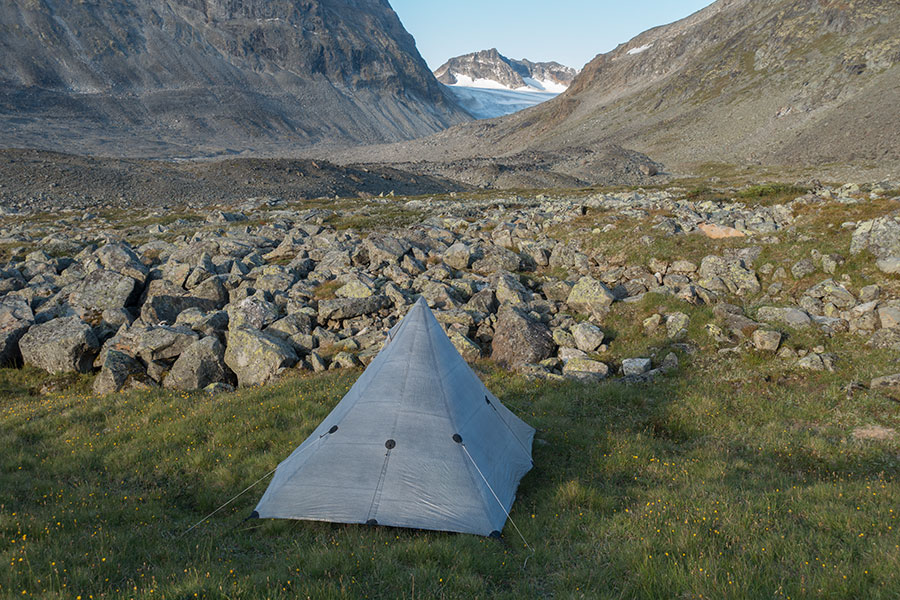
The Khufu is a one person, trekking pole supported, modular pyramid tent in DCF fabric. On this trip, I used the 2/3 mesh inner and the inverted-V pole extender for a two-pole, A-frame support.

The Locus Gear Khufu mid

Wind performance

I routinely used all staking points, 12 total, due to the mostly exposed locations but I fortunately never went through strong wind in camp so, unfortunately, cannot report anything new in this regard. The Khufu feels solid but I’ll need to wait for a tougher test.

Front view, fully staked down

Rain performance

I went through heavy rain and the tent handled it very well. The one thing that stood out as a major improvement over my previous default shelter, a MLD Silnylon Trailstar, was that the Khufu kept a drier environment inside overall. I had condensation but no misting, which I had often found as an outstanding problem with the Trailstar.

Most likely factors are the steeper walls and the use of an inner, even if its walls were mesh. I don’t know if the DCF fabric would make a difference over silnylon in waterproofness or condensation in practical terms.

I remember the wet conditions I often went through inside the Trailstar and how much of a problem that can be in a wet place like Norway together with my using a thin, summer season, down sleeping bag whose insulation can get compromised. The Khufu was significantly better in this regard. It still is my default shelter for the long distance.

Short side view

Waterproof top – Houdini The Shelter Anorak

I’d remember how vulnerable I had felt in the past in the Norwegian rainy weather in my default lightweight waterproofs and I had it clear I needed an upgrade so I got my first 3 Layer top in decades, hoping to up my game. I’m not sure how much it worked.

The Shelter Anorak is a design I like, pullover style with a loose fit and long enough to cover well beyond my waist. It was virtually new at the beginning of the trip.

Houdini The Shelter Anorak

My reservations are with the waterproofness. I’d expect a 3 layer, new garment with a 20K column to be seriously waterproof. The one issue that stood out from first use was that drops would impregnate de face fabric and wouldn’t bed off. This was shocking, every non-waterproof, cheap wind jacket I’ve used had better face fabric water repellency than this anorak.

The membrane layer would obviously be the main barrier but the outer fabric non-repellency was a bad start.

In practical terms, when I took the anorak off after any serious rain, I had some wet spots in my base layer, mostly in the elbow areas but nothing dramatic. It certainly worked better than my previous lightweight items but it didn’t meet my expectations. As stated above, my experience with 3 layer waterproofs is limited and I acknowledge this may be what it is.

Waterproof trousers – Rab Downpour Eco

Same as with the top, I felt the conditions in Norway demanded an upgrade over the minimalist items I had been using for years while keeping conscious the bottoms are less critical than the top, particularly when this latter covers well below waist level. That said, I wanted to feel like I could be hiking under the rain for hours and not take a full soak for granted.

I didn’t want to go for anything very fancy or heavy, didn’t do any deep market research and went for a safe bet with a decent record. The Downpour Eco from Rab worked well and it was not overloaded with features. The only extra it includes is the bottom leg zip which offers the obvious ease for on and off as well as takes my only down point. Bottom of the leg zips are an obvious weak point with a potential for failure, which is what you get with zips when they have to mix with dirt and rubble:

The flap cover helped but it was not enough

I acknowledge rain pants are not meant to stay on continuously so such zip may still outlive the garment. On this particular instance, the pants were new at the beginning of the trip and the zip didn’t show signs of down wear by the end. I could go with a non-opening and accept taking shoes off and on every time. If the opening is included in the design, I’d say hook and loop would be more robust.

Waterproof double layering

The idea here was to carry a second waterproof top and layer it on top or below the anorak in long lasting or heavy rain. At the risk of excommunication from the lightweight faith, this is as far as I was ready to go to feel like I could face the Norwegian weather and be comfortable with it.

The logic goes like this: every waterproof I’ve ever worn has been overwhelmed sooner or later and I didn’t expect my new, 3 Layer anorak to be an exception, just maybe a later. By doubling the waterproof layering, I would expect not only to postpone the getting wet yet more but I’d also look for some kind of synergy or added value.

This was meant as an experiment more than a heavier but sure-hit strategy. Testing conditions would require sustained, heavy rain in a thru-hiking context, in other words, what works in a day hike with a day pack may not do when out for longer with a bigger load. I wondered if the double layering would prevent wetting out for longer than the theoretical added times of each layer but which were these, anyway? In the end, my expectation was to feel better protected and more resilient to hiking in wet conditions for an extended time and to have a rough impression about this being worth the additional weight.

I considered several options for the second waterproof and eventually went for a poncho for several reasons: a garment different from the anorak so there was some potential for synergies as both pieces had their particular strengths and weaknesses. Then, the poncho would go over the pack, covering it better than any pack cover would and easing ventilation, thus minimizing the risk of too much waterproofing creating very damp conditions from within. I chose a Frogg Toggs poncho I had lying around, which is rather fragile but fairly lightweight. Vegetation at torso height is usually not a big issue while hiking in Norway.

Other than the added weight, what could go wrong?

Several things did. Mostly implementation’s fault more than the idea’s.

Number one, and this is a silly one, putting a poncho on over a full pack was an exercise in frustration, ridiculously difficult for such an apparently simple task. It may be related with my own arm reach. To me, it would always take several tries. Not that I’d be in a hurry but you don’t want to be fiddling with the waterproofs wearing when it’s already raining. This was an issue already known to me from previous trials of a poncho for backpacking but this time the paper-like nature of the Frogg Toggs fabric only made it worse. It’s very lightweight and doesn’t slide well over other surfaces so it was extremely difficult to get it to fall naturally behind the pack when trying to wear it upside down. A nylon poncho would have faired much better.

Number two, the poncho I used was not big enough. Not so much of an issue length-wise, being an additional layer over a full size waterproof system (I was using trousers too), but most critically volume-wise, which links back to the consideration of the big volume of a full thru-hiking pack and brings me to the next and main issue.

Number three, the snaps providing the side closing for the poncho were not meant to stand to much pull forces. Together with the limited volume of the poncho, it made the snaps come undone frequently and too easily, leaving the sides exposed and, very often, the front and back of the poncho flying around, exposing pretty much everything they were expected to protect. I’d end up breathing softly and crossing fingers, there was little else I could do.

All these problems would reveal specially when the pack was full. The whole thing was so unworkable that I ended up using the poncho as an oversized pack cover, giving up on the double layering and feeling silly about my poor choices.

My pack, impersonating ET

When food volume went down, I could use the poncho as it was meant to and, if pack volume was low enough, the whole scheme worked quite well but the limited test time didn’t allow for clear conclusions as to the validity of the idea.

Ghost selfie in heavy waterproofs

Next time I travel in Norway or other similarly wet place, I plan to try this idea again but I’ll definitely change the Frogg Toggs poncho for a woven fabric one that can be closed securely along the sides and has ample room to hold the pack at full load. Alternatively, I might go for a torso-only double barrier and leave the pack out of the system, a poncho-over-pack is always tricky when the latter is thru-hiking size.

Trousers – Ternua Ward PT

You may not know the brand/model but it’s a fairly common design across well known makers. I had reservations about its suitability for summer thru-hiking in Norway, which is the core of these comments below.

These pants are soft-shell, bi-component, 4 way stretch and black in color. Despite my general dislike for stretch fabric in trousers, I liked these ones from the second I tried them at the store. They were very good quality in fabrics, patterning and making and they were the closest you could get to a rock-star look in hiking clothing. My reservations were about the combination of a fairly thick fabric, the black color and their standard, non-convertible design having the potential for being too warm for summer hiking. Even in Norway.

Stretch, bi-component fabric is also slower drying than single layer, thin nylon, which is what I had used just the previous summer, also in Norway, with success and not a single time feeling I was too cold or unprotected.

I liked the Ward PT model too much to not give it a try though. It had pretty much everything I like in important design elements like pockets and lower leg hem cord-locked elastics so I could easily bring them up above the calf.

No kidding about the rock stardom

They worked very well and felt great overall. Not once I felt them too warm. While the bi-component fabric certainly takes more time to dry than single-layers, it’s also more comfortable when wet.

The most important statement here is whether bi-components are best for the Norwegian summer. Unfortunately, I don’t have a clear conclusion. Maybe it’s actually fortunate in the sense that the legs are too forgiving for any reasonable choice to work well.

Norge Midt section 4: Holden to As i Tydal

In July and August 2023, I hiked for four straight weeks and 825 km in Norway between Sulitjelma, County Nordland and As i Tydal, County Trondelag. I broke the route down into four sections based on time criteria with the associated part-day break and resupply. This is the story of my fourth and final week on the trail when I walked from Holden farm to As i Tydal town.

Fourth week

The Holden stay was healing in all accounts. Taking a break always is but this time it was full of additional meaning: the most difficult terrain was behind and I was only 1+ hiking day from rejoining the trail and hut networks for good. It was a job well done feeling.

The food fest, that key part of the healing process, was limited to the hut’s pantry offer but I can be more than fine with a canned stew, which is what I had for breakfast after a 6 AM wake-up call. Then I’m on the (off) trail again.

Leaving Holden

After the instability of the last few days, the atmosphere feels quieter and there’s no clear sign of rain in the short-term forecast so I tackle the start of the section with confidence. The initial stretch is still off-trail, about 8 km to change valleys over a short highland section and lots of open marsh. Beware of the potential for deep pools!

Don’t step here

Gaundalen is another valley draining east into nearby Sweden. The namesake farm at the edge of the marshy valley bottom is accessible on a dirt road across the border.

Gaundalen farm

My route stays in Norway, heading northwest on a well-signed trail going upstream, alternating marsh and thick, beautiful conifer woods.

Gaundalen woods

Shortly after the trail leaves the trees behind, I need to turn southwest to leave the signed route and go for the last off-trail stretch I’ll need to walk, 18 km to Setertjonnhytta and a trail network that I won’t need to leave for the rest of the trip. The terrain is a highland, where the ground is firm and the vegetation is no obstacle. With only a breeze and no rain, it’s among the finest hiking time I’ve had for some time. Lots of lakes, big and small, and some steep, rocky hillsides.

Big highland lake

The clouds thin and break for another evening of magical sunset light as I come down enough to meet the trees and marsh combo again.

Marsh and trees

Mostly marsh

I could have pushed for the hut area but no need, it’s a great night for a camp. About 4 km short, I find the proverbial rise in the wetlands with room for a lone pine tree and my tent. It will be a beautiful camp.

Lovely scene

Lone Pine camp

I had staked all the ridge lines down to assist with the exposed location but it was a quiet night in my sleeping quarters.

The Locus Gear Khufu mid

The area has been left out of the National Park owing to a dammed lake and its use as farmland, most likely incompatible with the park status. I’m certainly not alone:

Good morning to/from the locals

One easy ford later, I finally reach Setertjonnhytta and the end of my off-trail days. I celebrate with a good break and an early lunch at nearly breakfast time. Unsurprisingly enough, it starts raining again but I won’t get upset about it. It’s a day to not get upset about anything.

Setertjonnhytta

I leave the hut in intermittent rain and it’s clear the route scene has changed dramatically: heavy signage and wood planks over the marsh in strong contrast with the last two weeks.

Back in popular hiking grounds

Trail infrastructure

And a nice milestone I wasn’t aware of, Norway’s geographical mid point:

This slideshow requires JavaScript.

I go through a couple of trail junctions and a hut in short stretch, which emphasizes the contrast with what’s been my routine for a good while. As I reenter the National Park, the route takes along Skjaekerdalen in a mostly forested setting under beautiful light.

Skjaekerdalen

Skjaekerdalen

The route leaves Skjaekerdalen for a highland crossing and the light is truly amazing with the mix of blue sky and assorted clouds in different flavors. Hiking life is good.

Southern reaches of Blafjell-Skjaekerfjell National Park

By the end of the day and in typical Norwegian fashion, clouds gather again and I get some showers but it’s mostly just so I can get another rainbow. A highland plateau is the perfect setting for a camp in quiet weather conditions.

Pine tree, heather, rainbow and Khufu

Sunset is outstanding from my vantage point.

Colorful sunset

Veresvatnet below is profiled by its own cloud cover in the early morning. The mountains in the background are across the border into Sweden. My camp happened to be literally at the southern border of Blafjell-Skjaekerfjell National Park. As I resume the hiking, I leave the park behind for good.

Cloud over the lake

Down in Veresvatnet, there’s the dead-end of a road with a lively farm area and a DNT hut that I won’t need to use this time. Most farms I’ve met so far in the trip have been about cattle in grazing fields, it’s interesting to also see crops.

Norwegian farming

There’s data reception and I check the weather forecast which announces the lull is over, rain is on the way later in the day with more to come the following. I prepare for rainy weather by checking the hut scene and I find no good match with my timing. I’ll meet a hut for a lunch break but not for the night unless I go for a terribly long day.

I’m not sure whether making haste or not. I do while taking advantage of a rare stretch of trail provided with never-ending lines of wood planks over the marshes where progress is easy and quick but the plan, if there ever was one, is ruined when I need to fork into a much poorer trail with no visible tread where even signage is lacking to the point that I loose it completely. In a haste-induced, bad decision making, I go across a marsh section that was too deep, if only for a few critical meters, and find myself stuck, both legs sunk beyond my crotch and unable to move.

If there was one time on this trip when I was in trouble, it was this one. I didn’t know if I’d keep sinking and, even if I wouldn’t, whether I could get myself out or not. I moved slowly trying to find a hold and get my last leg in, first out onto more stable terrain, literally 40 cm behind me. Luckily, it worked.

Cruising over the swamps before getting stuck

It starts raining literally minutes before I arrive in Bellingstua. I have my lunch under cover and ponder my options. It’s early afternoon, there’s another 28 km to the next hut and I certainly don’t feel like pushing that hard so I take my time and leave Bellingstua under intermittent rain two and a half hours later aiming for a wet weather camp.

Ghost selfie in heavy waterproofs

I walk 16 of the 28 km in very damp conditions even if it’s not raining much and make camp in a miraculously firm grassy spot with some sheltering relief. Heavy rain was forecast for the night but it never happened.

Comfy camp after all

In the morning, it looks like it could rain anytime and it does literally minutes before I get to the Ferslia hut. My very early wake-up call is paying off.

Welcome porch for the wet stuff

Ferslia is close to a road and a farm area and I have reception so I can make plans based on good data. Heavy rain is expected for the next few hours but it should ease in the afternoon. With only 13 km to the next hut, I decide to wait the weather and hope to leave on time to cover the distance and be under a roof for the night.

It does rain heavily and it seems like it’ll never stop. By mid-afternoon though, it’s only a drizzle and I set off. It’ll be a climb to the highlands followed by a hillside traverse, a pass and a climb down into the same watershed I had climbed up from. The air is heavy.

Very grey

I could expect the highlands to be misty and I could only hope the signaling was good enough. I concentrate on following the trail under horizontal drizzle.

Thick fog

I keep wondering if it was a good idea to try this when I could have just stayed in Ferslia. Other than the obvious need for progress and avoiding a very short day that would ruin my stats, the next hut in Angeltjonn feels more attractive, being in a more remote location and I’m fixed on going for it. However, the trail had other plans. 5 km into the death march, I meet this:

Swollen

It was a mountain stream whose headwaters were just a few km upstream, just a thin, seemingly harmless blue line in the map representation but it was heavily swollen with the ongoing rain.

I prepared for the ford, waterproofing all my electronics and paperwork, then got into the water. It was clear it wouldn’t be easy and it immediately became clear it would be dangerous. I got almost crotch deep right from the first few steps, barely manageable in the relatively slow flow near the bank. The current was powerful in the middle section, which I could also expect to be deeper. No way I could go across.

I scouted for an easier ford, found none in close proximity and decided it was not worth the risk or even the bother of travelling upstream fighting wet vegetation in the ongoing drizzle with no clue about for how long.

I didn’t even consider camping in the area. With a known hut 5 km behind, I had it clear I’d backtrack all the way to Ferslia and try again in the morning.

I was back in the hut by early evening, got the fire going, hanged everything in the drying room, relaxed and hoped for the best for the following day.

Drying room in Ferslia hut

I resumed by 7 AM. It was still misty in the highlands but not as much as the previous afternoon and it wasn’t raining. I was not alone in the area:

Reindeer

I got to the problem stream and the difference was dramatic:

Back to normal

It was an easy ford, far less deep and with a pretty quiet flow that meant no risk. It’s well known how much conditions can change in a few hours but it’s still remarkable to verify on the spot. No matter how much of a commodity hiking may seem to have become, Norway is still a tad of a wild place that can easily bring the hiker back where it belongs in the grand scheme of things.

The fog lifted and I could have an eventless highland crossing followed by a downclimb to the shore of Fjergen lake, where I’d meet the hut I was aiming for the previous day.

Light and dark yet again

Fjergen

Angeltjonnhytta was a lovely backcountry hut that I certainly missed staying in. It was busy with some local hikers still in the process of recovering from the previous day beating. I could empathize with them. I had my lunch in the bench outside and kept going.

Angeltjonnhytta

The trail climbs high for a long section where it literally borders Sweden for a good while. I met some more reindeer. The clouds started breaking and it was even warm.

Hiker under the clouds

Hiker in the sunshine

I eventually come down to Teveldalen, a main east-west valley with a trunk road and railway track, both crossing into nearby Sweden. This place was, in normal hiking conditions, the least ambitious of my possible ending points, there’s a railway station a few km into Sweden where I could have taken transport straight into Trondheim. As it goes, I still have one and a half day hiking time in front of me.

There’s also a lovely mountain lodge in the area but the current sunny conditions are not to be missed and I keep going onto the following highland aiming for a camp. It was an obviously good move.

Camp above Teveldalen

Sunset was spectacular from my hillside bench, together with that gift that’s a cloudless sky in Norway.

Sunset

Sunset

Sunrise was not too shabby either:

Sunrise

Sunrise

My last full hiking day of the trip is an actual gift in virtually perfect conditions, it has it all: mostly cloudless throughout, calm, mildly warm and what’s more, almost unbelievably dry underfoot to the point that it wouldn’t look like I’m in Norway anymore if it wasn’t for the low light angle, even at midday.

And a good trail

I visit lowlands below 600 m with some lovely birch woods, then climb again for a final highland section that at times looks like a designer garden with the stunted birch and the colorful heather.

Riverside birch

Birch and heather

Birch, heather and hiker

My latest wide panoramas have the background of the Sylan mountains across the Swedish border.

Sylan hills

By late evening I come down to the Storerikvollen hut complex by the shore of giant, dammed Esandsjoen.

Storerikvollen hut by Esandsjoen

The place is too lovely to skip but the conditions are also too good to stay indoors and I prefer to camp for my last night on the trail anyway so I go for some middle ground by staying in the hut complex area and pitching in the camping corner, which is always an option in Norwegian huts.

Storerikvollen

One last camp

Sunset was lovely once again:

Last light

Come morning, it’s only 21 km, most of them on a gravel road, to come down to the Tydal municipality where I’ll hit a road and a one-trip-a-day bus line that I need to meet by mid afternoon. Perfect hiking conditions once again.

As i Tydal

Gravel road

I actually made it a bit longer by avoiding a most probably wet final trail stretch and taking the gravel instead so I could walk my feet dry before coming back to the urban world. I made it to town before noon.

Gravel turns to tarmac, As i Tydal

Only a handful of trail mix and half a block of biscuits were left in my pack but they weren’t appetizing anymore. I had some initial celebration meal while waiting for the bus.

Leftovers

Pizza & coffee

In a little more than 2 hours, the bus would take me to Trondheim where I’d do some proper partying, ie walk around with no pack, eat plenty. Celebrate a trip well done.

Norge Midt section 3: Royrvik to Holden

In July and August 2023, I hiked for four straight weeks and 825 km in Norway between Sulitjelma, County Nordland and As i Tydal, County Trondelag. I broke the route down into four sections based on time criteria with the associated part-day break and resupply. This is the story of my third week on the trail when I walked from Royrvik town to Holden farm.

Third week

Week 3 is bound to be the key section of this trip. It will concentrate most of the off-trail in long stretches where I don’t really know what to expect other than it will be passable but no idea at what price. If nothing else, it will be slower going and I’ll be more vulnerable to rough weather conditions. I’ll also be mostly away from the hut network. It feels exciting and daunting in similar amounts.

For the time being, it’s Monday morning and I need to wait until 9 AM for the supermarket to open so no need for the usual early wake-up call. By the time I finish breakfast, it’s already wet outside and the forecast is for occasionally heavy, sustained rain throughout the day. Very tough conditions but I have a plan.

The initial 18 km south of Royrvik are easy walking on dirt and tarmac roads, just before climbing to a highland, off-trail section. This latter has all the potential for disaster in the current conditions. Shopping and packing will take a good part of the morning though so it makes all the sense to plan for a short day and make camp in a sheltered spot before climbing into the unknown.

With this in mind, I wear my poncho to walk to the grocery under the rain. It’s a sizeable supermarket for a relatively small town but I guess it services a wider area. Beware of avoiding getting to town on a Friday late evening though, you’d need to wait until Monday for a resupply!

Closed Sat and Sun

There is a post office counter inside so I take the chance to send away my used paper maps. Nice touch about the freeze-dried food option, which saves the search for some dinner-worthy meal I can cook quick in a pot of limited size. Other than that, I can easily find all the usual staples.

Food for yet another week

There will be a reasonably good chance for another resupply but only 3 days into the section so I don’t plan on using it. In fact, there won’t be another for the rest of the trip but by the end of week 3 I’ll be in the hut network again in a region where most huts have a pantry room so my idea is to survive to trip’s end by using the limited options in the huts together with my leftovers from Royrvik.

Even with the prospect of the favorable terrain, it takes some courage to put the pack on and step out of the Limingen Gjestegard so I wait for a lull in the rain and wave goodbye to the welcoming scene of my last 24 h.

Limingen Gjestegard

After an initial bit on the main road, the route takes a parallel gravel track. I almost miss the former, it had very little traffic and I could keep my feet just mildly wet. The track soon turns into a wet mess where my feet go back to the usual soaked. I know it’s a fact of Norway hiking but still a bummer after some town time.

Wet feet guarantee

I get ocassional views of Limingen lake, one of the largest fresh water lakes in Norway.

Misty Limingen

Eventually I go down to the main road again at a junction where a fork turns west bound for the outer world. It’s a virtually deserted road on a Monday afternoon that I need to follow for a few km to the base of the hills where the road enters a tunnel and I leave it for the off-trail highlands.

Empty road

In strong disagreement with the forecast, the rain has pretty much stopped and I can have a moody, yet easy hike up the road to the tunnel entrance, where I take a side into the last of the birch trees to find a dry spot for the tent.

Monday camping

There will be some heavy rain later but I’ll be comfortably installed by then. Rainy weather shows the value in a workable tent porch:

Dinner

The forecast for the following day is still sketchy but less dramatic. It’s overcast in the morning but at least it’s not raining and I get ready for a low-light kind of day. Right from camp, I need to climb onto the highlands. It’s cross country over grass and rock and I’m particularly relieved that there’s no mist or rain, either of which would make things difficult. In their absence, it’s just slow progress over rough terrain across beautiful landscapes dotted with lakes.

Steinfjellet

It’s about 13 km before the route takes me down and, without much vegetation or marsh struggle, straight onto a farm area at the end of a gravel road which I need to use all the way down onto the main road I had used out of Royrvik the day before. It’s rather narrow and undeveloped but still the main one in the area.

Inner Norway roads

Motor traffic is extremely low and the scenery is nice, particularly while the road borders giant Tunnsjoen, the other big lake in the region.

Tunnsjoen

It’s about 15 km where the NPL3 route that I’m following has been traced over the tarmac. Looking at the topo maps, I could think of another highland section that would have saved a few of the 15 but most likely at the cost of a rough way out across dense conifer woods and I trust the route designers chose the lesser evil.

The road is the only option in an area where water has taken over most of the lower land and there’s only a bridged, narrow passage between big lakes before the final push onto Skorovatn, which happens to be an actual town, albeit small and where the very limited services are all hosted in a building that’s closed and deserted when I get there by 6 PM. Never mind, my plan includes Skorovatn and the DNT4 hut in town, the first one in many days and the last one I’ll meet before the end of the week. If only for that, I had planned to stay indoors for the night.

Skorovatn hut

It’s a front country hut with running water and wired power. By the time I get there, clouds have broken and it’s even sunny at times, what am I doing indoors in such conditions? Other than the disaster plan I was carrying from Royrvik, which included a Skorovatn stay, the thing is the wind has picked up to worrying speeds, even in the sheltered town location so I feel righteously fine inside.

What’s more, the forecast is for very strong wind the following day. Norwegian weather takes no breaks.

I can certainly feel the breeze when I step out by 7 AM. It’s a long and remote highland ahead that will take the whole day. The initial 12 km are on trail, the remaining 20 cross-country. The vibe feels bright despite the dark clouds dominating the scene. The easterly wind is powerful but manageable as I climb along west-facing slopes that offer some partial protection. It’s often difficult to show the wind in a still picture and my best efforts at that were this waves is a small tarn and the waterfalls being blown upwards:

Very windy

Very windy

It’s a shame about this wind because the day is a memorable one otherwise as the route goes across this huge upland of rock and grass dotted with lakes all over the place. It’s really beautiful and the off-trail course makes it feel more remote than it probably is. The highlands of Nesafjella.

Nesafjella

At some point though it blows so hard that it knocks me down. With the wind in my face, I can barely move forward and I start to worry about the rest of the day. I can’t think of any real progress in these conditions. Funny how the wind works anyway because as soon as I leave the summit area I was traversing, it eases enough to be bearable, even if I’m still windward and the topography is rather smooth.

My impression is that the wind has eased somewhat and it was about time because the route takes me over a secondary summit in very exposed terrain where I would have suffered some major beating. It’s still blowing hard but I can stand.

As I start the climb down, it feels like victory of the relieved kind. I can see far away and recognize the big lakes at the far end where I’ll hit a farm area and I can also scout all the cross country terrain that I’ll need to go through to get there. I’m aware it’ll be hard work but apparently nothing I haven’t done before. I was wrong.

There were obstacles I couldn’t see from above. In fact, I couldn’t see those gullies until I was on the very edge. A series of sharp cuts that I needed to go across with no way around. They weren’t that deep, about 10 m average, but the walls were climbing terrain. I had to scout carefully for a weak point to go down and a matching one to go up again hoping it was the last one, only to find another shortly after. At some point, I lost my patience and made a poor choice that almost cost me a bad fall. Good decision making is key and this was a good reminder.

Eventually, I reach lower land and more familiar terrain, the usual mix of woods and marsh. This is known hardship and I feel comfortable with it. Victory again.

When the endless marsh is welcome

I get to the dead-end of a dirt road that gives access to some winter ski routes in the area. I could push to the farm areas ahead but I reason it’d be easier and more private to camp before that so I find a dry spot in a clearing in the conifer woods. The wind seems long forgotten but I’d be well sheltered anyway. There was some beautiful light that I take as my reward after a very tough day on the trail.

Calm after the storm

Day 4 out of Royrvik starts quiet and beautiful with the usual mix of clouds and clearings and some lovely light as I do quick progress on the dirt road that soon turns into tarmac as I reach the farms on the shore of Skjeldbreitvatnet. The valley bottom is a series of lakes and connecting rivers and I need to reach the main east-west road to find a bridge across. Relaxing times with easy walking for a while.

Easy walking for a while

Once across the valley, I need to leave the road straight away into the woods, thus entering the longest off-trail stretch in the trip where I’ll be traversing Blafjell-Skjaerkerfjell National Park. It’ll be two full days before I meet a trail again.

Skjaerkerfjell is huge, it’ll be 4 full days across the park, most of it off-trail and my beacon at the time is Holden farm, where I’ll temporarily get off the park limits and find a DNT hut where I plan to take some break.

I’ve heard some warnings about the difficulty of Skjaekerfjell but nothing specific other than the boggy terrain. I argue it shouldn’t be much worse than anything I’ve already met. I’d be more weary of tricky topography, which is not often an issue in Norway unless you’re actually looking for it but can still happen, even in micro-amounts, like I just suffered the previous afternoon. Actually, the biggest obstacle in Norway, and particularly in these relatively lowland areas, is the rivers but it’s clear from the map that the route has been specifically set up to use existing bridges over the main flows. I wonder about an alternate route closer to the local watershed that should be drier while avoiding valley visits. Such alternate wouldn’t be any longer but it’d be more remote and exposed with no shelter options. With rain in the short-term forecast, I prefer to trust the designers and stick to the standard route.

The approach to Skjaekerfjell is the well-known chore of woods and marsh to tackle with patience. There are many clouds but that’s no news, clouds are almost always there in some form or another, and rain is not expected until the following day. Actually, sunshine wins for a while.

Sunshine wins for a while

The route takes me to a weak point in a ridgeline leading into Almdalen across the Skjaekerfjell border.

Almdalen, looking downstream

The Alma river in that valley is too big to ford but there’s a bridge a few km downstream. The bridge is in the middle of nowhere as far as access trails, of which there are none, but I guess it’s a key infrastructure to communicate both sides. Here is where I could have turned upstream instead, looking for the higher fells and going around the headwaters of the Alma. The map shows some steep terrain over that way that might be difficult, might not but I’ll never know. What I did know is the route downstream was seriously tough.

It was about 7 km along the hillside and it was about choosing the right bench. My feeling at the time is I not always did the best choice. At some point, I found myself on a course to the valley floor, which was probably a bad place to make progress, and needed to backtrack. Pissed of with the idea, I scouted the steep hillside to find a viable way straight up to regain the correct bench, some 50 vertical meters higher.

Trying to amend one mistake by committing another is always a bad idea. I saved the backtracking at the price of a sketchy climb over an occasionally unstable, consistent 50 deg slope. I wasn’t happy even when I was over with it.

Eventually, I came down to river level at the bridge area. It was indeed bad terrain for walking, very rocky and thick with vegetation. Right before the crossing, there was this private hut that I could not access. Hut and bridge location were surely related.

The opposite side of Almdalen was a breeze in comparison, still off-trail but just the usual, gentle uphill over grassy terrain and I took an emotional break while dragging my tired body for a few more miles until I went by the perfect, dry and grassy bench and set up for the day. Dusk was spectacular.

9:03 PM

9:50 PM

The following day, the clouds are still there.

Bukvatnet

Rain is expected anytime after mid-morning even though my recalling is it shouldn’t be of the non-stop kind. It’s looking certainly gloomy as I go across Bukvasfjellet, down some Pyrenean-worthy slopes and along high moorland before the smooth relief allows views of Lurudalen and the Gresamoen farm.

Inland Norway landscapes

If I trust the maps, it’s a giant marsh down there. The route goes down to meet the access dirt road where it crosses the river over a wooden, vehicle worthy bridge.

Laarte Luru flow

On the opposite side of the river, there’s the farm buildings in Gresamoen. I’ve been through remote farms before, some on this very trip, but I think none as much as this one. It’s a hell of a lot of miles west over a dirt road to get out of here and into any other built area. The Blafjell-Skjaekerfjell National Park limits have been traced so they just skip the farm. At the time I go through the place, it seems empty. I see nobody and no open doors. Rain starts falling gently and I take a lunch break on a shed porch.

Gresamoen

Rain is intermittent and I resume the hike over marshy terrain along a bit of faint trail that helps with the lush bits. It’s good to find the way out onto higher ground where progress will be easier.

Spot the trail

Way out

Afternoon and evening goes across endless moorland, often under the rain. Here is where I’d miss a marked route to help with the route finding when dealing with stuff is least welcome. Cross-country, it’s not possible to just keep your head down and keep going.

Showers

By late evening, clouds break and I get some welcome light. Showers are still around and I get a rainbow.

Full rainbow

I come down to this mix of trees and marsh around the tree line and find a dry spot to enjoy dusk around the pine trees. I’m only 4 km from rejoining the trail network.

Lovely light to end the day

By now, it’s been a while since I could last check the weather forecast but if I trust the latest update rain is expected again the following morning so I do a very early wake-up call to try to reach a catalogued trail for the first time in two days before it starts pissing down.

5 AM wake-up call

It’s only a partial success and I get wet again soon after departure but by 8 AM I spot my first cairn this side of the big void.

Long awaited cairn

It’s overcast and rainy but even if there’s not much difference in the actual walking, once I’m on trail it’s so much easier to follow the route and I feel like nothing can go wrong now, at least not before I get to my next planned station in Holden Farm, some 20 km away.

Such is my disappointment when I realize there’s still one cross-country section and I really need to swallow this one. Looking at the terrain, I feared a bad fight with wet vegetation but in the end there was always a way through and it wasn’t that bad. Eventually, I got to the shore of Langvatnet and a well marked trail, at last.

Highway to Holden

Holden is a working farm with no land vehicle access but the location somehow feels less remote than Gresamoen did the day before. May be the ongoing activity or the now improving weather but also that it’s closer to the road network even if it’s across the lake and the Swedish border. One of the buildings is a DNT hut. It’s mid-afternoon and I’m not moving anymore today.

DNT hut in Holden

It’ll be time for a much needed break after my toughest hiking week in a long time. Gear drying, general assault to the pantry room and some quality time by the lake or the fireplace.

Holden

Holden

Final week of the trip awaits.

Norge Midt section 2: Umbukta to Royrvik

In July and August 2023, I hiked for four straight weeks and 825 km in Norway between Sulitjelma, County Nordland and As i Tydal, County Trondelag. I broke the route down into four sections based on time criteria with the associated part-day break and resupply. This is the story of my second week on the trail when I walked from the Umbukta mountain lodge to Royrvik town.

Second week

After the due sleep, the only inalienable thing that’s left for me in Umbukta is a hearty breakfast. I make a big event of it, even if I’m on my own in the dining room. Then I need to put the pack on and step outside to brilliant blue skies.

Gresfjellet and Storakersvatnet

The route skirts the Swedish border at a sharp bend of this latter, a series of oddly straight lines drawn across hills, valleys and lakes with no apparent geographic criteria. I do a short detour to the closest border cairn. I recall similar ones from my 2007 Nordkalott hike.

Border cairn

Then I come to the first view of the Okstindan ice. There’s a big icefield on top of those hills and several flowing glaciers on the slopes.

Okstindan ice

I’ll spend the rest of the hiking day going around Okstindan while enjoying the fine weather and cursing the oddly difficult terrain on a long, lakeside stretch, then crossing marshland in front of the east facing glaciers.

Okstindan east side

Once off the marsh, I can find some dry grass among the stunted birch for a quiet, nice camp overlooking the hills.

Camp birch & ice

Very different light on the same spot in the morning:

I didn’t oversleep, dawn is very early in the northern latitudes

I go by one of several lavvu that I’ll meet along the trip, it’s a teepee structure made with leaning tree branches and often wrapped in a layer of ground where moss and grass grow. It wouldn’t look like a shelter if it wouldn’t be for the door.

This slideshow requires JavaScript.

The route leaves the valley floor in this usual move to avoid the worst of the marshy terrain even though the final goal is to keep downstream. Light and dark alternate.

Light and dark

Eventually, I come to the view of my next goal, the north arm of giant Rosvatnet:

From the catalogue of Norwegian lakes, Rosvatnet

Down there, I meet the tail end of a narrow tarmac road that gives vehicle access to a few farms at the north end of the lake. Below 400 m, the woods are thick enough to hide anything not immediately behind.

Dead-end road

It’s in this area that I get aware of a meaningful change of scenery. All the way here from departure, I could still relate to the environment I’d remember from my Nordkalott hike in the far north of Scandinavia: it was all high fells with the occasional visit to a valley going below the tree line and very limited instances of a road crossing. Today and as I proceed south along the border with Sweden, the terrain is lower in average, the highland sections are shorter and I’ll be meeting a west-bound road in every main valley. This new routine will last for about 100 km all the way to the gates of the big wilderness that’s Borgefjell National Park.

I’ll be closer to rural urban areas but the hut network will be less dense. It feels more remote in a way because it seems it’s a region less popular for hiking. At least, I’ll keep within the trail network until Borgefjell.

With all this in mind, I cross over a short highland section to come down again to another similarly patterned farm area, this time the access road is dirt.

Famvassdalen

I get cell reception in this area and I can verify rain is on the way for the following morning. For the time being, the sky is only moody gray and I find the proverbial patch of dry grass for another comfy camp.

Camp birch & header

It’s overcast in the morning and it certainly looks like rain is about to start anytime. I make plans for a hut break, if needed, with an early start to try to avoid the worst of the weather.

Back to daytime darkness

Linking to the previous comment about the change in scenario, it’s worth noting the DNT1 hut network will be gone for me for about a week. There will be emergency huts and some chances of farm/campground accommodation but the convenient regularity of the DNT huts will no longer be there for almost two full weeks. So far on this trip, I’ve been meeting one of these huts twice a day most days, which makes the prospect of rainy weather quite bearable with the option of waiting it inside.

This time around, there’s luckily a hut option 4 h from camp, only not a DNT one but when I arrive there after quite some time under serious rain, I’m happy to see it’s just as comfortable, including a sizeable porch for all the dripping stuff.

Good place to be on a rainy day

It’s only mid morning but I’d be happy to spend the rest of the day here. The forecast is inconclusive for later so I still hope the rain eases enough to make it easy to leave. With that in mind, I take the break for an early lunch.

There’ll be three other wet hikers arriving in the hut as I was there, all of them NPL5 northbounders. They got the fire going, which I hadn’t. I think they’d had enough of the rain for the day and were probably meaning to stay for the night, which sometimes makes all the sense. Hiking the length of Norway in one go is tough enough to guarantee a break whenever it feels. I never dismissed the option but this time I was mentally ready to leave at the slightest chance.

By early afternoon, the rain had eased and the cloud cover was clearly thinner. Together with a so-so forecast, it was enough for me to decide to keep going. In a worst case scenario, it’d be less than 20 km to the next lowland and the chance of farm accommodation but the highland crossing would be a long one. I’d be in the hands of the weather gods.

This section of the big route along Norway goes under the Nordlandsruta name, not heavily pictured in the signaling. As per my recalling, this is only the second such sign I meet and it feels rather unofficial:

Through the grass

I cross another road, this time not a dead-end but and east-west way going into Sweden, the border just a couple miles away. Barely any traffic. I happily leave the road behind.

The sky is getting clearer and by the time I reach the highlands the clouds have broken enough to let some light reach the cottongrass.

Final climb

I’m so glad for the weather window because it’s real beautiful up here, the paradigm mix of green grass and blue lakes plus easy walking with little rock, and I can enjoy my time in the area.

Grass and water

Easy walking

Clouds gather again and I get a good shower on my way down, which takes a good part of the optimism away from me and I decide on the go to use the option of the Tverrelvnes farm, which offers accomodation. There’ll be some more rain but I’ll be indoor by then.

This slideshow requires JavaScript.

I’ll have the place to myself that night. Not busy.

Tverrelvnes is at the very end of a dirt road giving access to several farm areas. There’s cell reception. Not much of interest on the waves for me at the time except for, guess what, the weather forecast, which is dead clear this time: heavy, persistent rain from noon onwards the following day and I make plans to be indoors for the episode. It won’t be difficult, the next valley is only 12 km away and there’s Grannes Camping there where I’ll be happy to get a cabin and wait the rain.

With this prospect, I spend a happy morning enjoying some good hiking in extraordinary light. The clouds are ominous but the sunlight still makes its way.

Stormy clouds, morning light

Nordlandsruta sign

Garsmarkelva flow

Still shiny

It’s a success story. I make it to Grannes by mid morning in still dry conditions.

Grannes Camping

The place is far from glamourous and the smaller cabins look particularly decrepit but I have a fireplace and a porch and I have it clear I won’t be moving from here for the rest of the day. Fingers crossed for the next morning.

This slideshow requires JavaScript.

It did rain for the rest of the day and most of the night. I spent some quiet, lovely time watching the rain, my only issue not being able to freely go through my diminishing food supplies with still 3 days worth of hiking in front of me before I could replenish. No services whatsoever in or around Grannes. Hattfjelldal town was only 25 km down the road but with no apparent chance of public transportation and very little traffic whatsoever, I concluded going there would be more a problem than a solution. I stayed in Grannes.

The following morning, I kept browsing the precip animation in the forecast to see it move around and clear my location by mid morning. I wouldn’t wait for so long and left Grannes still in the rain while steering clear of the puddles trying to keep my shoes dry, if only for a few minutes.

Wet Grannes

The rain did stop and the subsequent mix of cloud and light offered some scenic views back down the valley and another memorable highland crossing.

Valley getting dry

Highland stream

Coming down into yet another east-west valley, I had a first crash with what was about to come for long stretches in the next 10 days: a fading trail in bushy areas where progress was tough and slow. Potential utter nightmare in rainy weather but just a reality check requiring some mental adaptation otherwise.

A narrow channel between two lakes provided some extra entertainment while riding this pull boat that saved a long orbital around the water. Poor trails but not devoid of key infrastructure.

No sail, no row

Another valley and another dead-end gravel road that I need to follow for 5 km before resuming along the trail network. I make camp in a convenient moorland bench just 7 km shy of the border of Borgefjell National Park.

10:30 PM

6:30 AM

Borgefjell is know for being the biggest wilderness area in this region and one of the biggest overall in Norway. There are no trails but, as far as my route through it goes, except for the way in and out, it’s all highland so I’d expect good walking on short grass. The access trail though must rank among the most awful paths I’ve ever walked, badly obliterated by more foot traffic than the marshy terrain could hold. Deep mud puddles.

Deep mud puddles

The Tiplingelva flow is the end of the trail network. Borgefjell is on the opposite side. I cross over the hanging bridge and under some blue skies.

Tiplingelva flow, Borgefjell border

Tiplingelva flow, Borgefjell peaks

The crossing of Borgefjell was one of the highlights of the whole trip. Once in the highlands, it was a rambler’s paradise of uninterrupted beauty that brought back memories of similar, long stretches in the Nordkalott.

Borgefjell landscape

Borgefjell landscape

Other than the chance of odd weather, the only meaningful obstacle in these locales is the streams. Even up high, they can be tricky to ford. The Ranserelva had a bridge but it required a considerable detour so I followed a straight line and crossed with great care.

Ranserelva ford

It took me most of the day to go across the high areas in this corner of Borgefjell. I didn’t rush. After the last pass, I had some drizzle but nothing serious. Best hiking in a long time.

High and remote, best hiking in a long time

More Borgefjell landscapes

Yet more Borgefjell landscapes

Still hiking Borgefjell

It was breezy and cold by camp time. Lakeside with a view for the occasion.

Virmavatnet camp

Morning is overcast, windy and cold with occasional showers and mist around camp.

Misty Virmavatnet

I come down from the highlands and cross from Nordland into Trondelag, below the treeline and into the usual mix of stunted birch and marshland. It’s fun to choose route and I alternate between the freedom of a straight line across open marsh and the more convoluted but firmer ground of the dry outcrops. It will still be off-trail for the rest of the day and I’m glad to verify there’s no impenetrable bush, the going is rough and slow but not difficult.

Colourful mushrooms

By noon, I reach Namsvatnet and the end of the climb down at the southern border of Borgefjell:

The Virmaelva flowing into Namsvatnet

The urban world is at the other end of the lake, 21 km bordering Namsvatnet that I presume tough because it’s relatively low level, just below 500 m, with no trails.

I was ready for a nightmare traverse here. The terrain is shown in the maps as a mix of woods and marsh and I would have guessed it’d be a tough choice between bad and worse with no clear clue which one would be which. It certainly required some mental adaptation, no 3 mph here, but it wasn’t so bad and I was happy with the challenge in a stretch that many thru-hikers seem to avoid by taking a boat along the lake.

After the early morning gloom, I had beautiful weather, which certainly helped. The conifer woods were thick at times but the often dense understorey is always soft and never thorny so it seems to always be passable. The marshes are always a beast of their own but they were walkable and sometimes they’d be a relief from the bush. Progress was slow but steady. I happily incorporate this bit of knowledge to my Norwegian hiking background.

Looking back north

Thick woods

Beach walking in Namsvatnet

Looking back across Namsvatnet, Borgefjell in the background

Cottongrass

Thick but passable

At the far end of Namsvatnet, I’ll meet a dirt road that’ll lead to a tarmac road and eventually Royrvik town. I make camp before any of that happens.

Yet another lakeside camp

Sunset at 9:30 PM

Morning is peaceful and scenic:

Sunrise at 5:30 AM

It’s only 17 easy km to the end of this section in Royrvik town. Shortly after leaving camp, I get to a dirt road giving access to some lakeside cottages, then onto the road network for the final push.

This slideshow requires JavaScript.

Royrvik is the only town in my route. It’s rather small without much of an urban plan but it’s got a supermarket and a hotel, which is pretty much all I’d need. I arrive there on a Sunday so I need to leave my shopping for the following morning. It’s only mid-morning and I have the rest of the day to do nothing, which is a great thing to do after the trail time.

Royrvik churchyard

The Limingen Gjestegard was a lovely place to stay, super hiker-friendly or just super friendly. Once again, not many guests around. Early August doesn’t seem to be high season over here.

This slideshow requires JavaScript.

I greatly welcome the break. I’m aware the following week can be among my toughest hiking ever and it’s set as the real challenge in this trip. Let me get some good rest and hearty food before that.

This slideshow requires JavaScript.

Heavy rain is in the forecast for the following day but I make a conscious decision to not worry. Not yet.

Norge Midt section 1: Sulitjelma to Umbukta

In July and August 2023, I hiked for four straight weeks and 825 km in Norway between Sulitjelma, County Nordland and As i Tydal, County Trondelag. I broke the route down into four sections based on time criteria with the associated part-day break and resupply. This is the story of my first week on the trail when I walked from Sulitjelma town to the Umbukta mountain lodge.

First week

Sulitjelma is a tiny mining town in a most typical Norwegian location, the narrow flat strip by the lake that fills the valley bottom. At 67 degrees north, it’s about half a degree beyond the Arctic Circle. I arrived there in the early evening of a Saturday on the bus from the coastal town Bodo, where I had landed earlier in the day on a flight from Oslo.

It was dark grey above with rain in the forecast but with two hut options within easy reach, I started hiking right away, not without pigging out for one last time in the local grocery. It’d be one full week before I could do that again.

Mandatory stop before departure

It started raining a few minutes after departure and I had my first crash with the Norwegian weather and with my decision making. Instead of donning the full set of rain gear, I was lazy enough to trust the rain would not be too heavy and wore only my poncho, trying also to keep cool on the long ascent from the valley floor. It’d have probably been good enough if I had only hiked the 4 km to the nearest hut but I also decided to keep going one additional hour to a smaller, more remote shelter. I was fortunate the trail was well signed because the mist got real thick at times.

Langvatnet and Sulitjelma

Misty highlands

I arrived in Lomihytta wet, cold and rather pissed off with the experience as well as relieved to be there and actually find the hut! It wasn’t straightforward in the low visibility conditions, even  with GPS help.

Home in the mist

Lomihytta was small and simple but up to Norwegian comfort standards and it saved my mood for the rest of the day. I went to sleep hoping the following day would be clearer.

This slideshow requires JavaScript.

Next morning, it was still overcast, dark grey but it wasn’t raining and the cloud had shifted enough to clear the ground except for the hilltops. Not the most encouraging conditions but technically fine. Off to my first full hiking day of the trip.

Grey morning in Lomi

South of Lomi, the route goes across the paradigm highland section where the actual trail is barely visible on the ground. I keep thinking how much hard work it’d be in the low visibility conditions of the previous evening. No matter the views, I’m glad to be back in the company of the this old friend that’s the DNT6 marker, I’m about to spend one month following it.

DNT marker on big cairn

The route goes down to the headwaters of the same valley I departed from in a couple of spots where I meet the birch trees and a DNT hut each time. I go past and keep going as far as I reasonably can for a first full hiking day aiming for a moorland camp overlooking Ballvatnet even though the smooth relief makes the lake barely noticeable.

First camp of the trip

My mood is as grey as the weather but I’m well aware how important it is to be here, doing this and I’m happy.

Next morning and everything is just the same. It probably helps the fact that, by mid-late July in these latitudes, nighttime is a very loose concept.

First morning in my tent

The route leaves the open ground around Ballvatnet to go across a saddle and down a valley. it’s easy walking in the low vegetation. For a while, the cloud feels thinner but this won’t last and it’ll soon go back to full greyness.

Easy walking in the low vegetation

Going down and into the lush green is very bad news: the vegetation multiplies its weight in water and I soon am seriously soaked from the knees down, very wet up to waist height. You couldn’t move without brushing on something that immediately releases insane amounts of water and it all feels very uncomfortable. The river views are beautiful though.

Skaitielva

I’m so wet I have this perfect excuse to plan for a hut night. The idea is a good fit as I’ll conveniently meet one of the DNT huts by the end of the hiking day. It wouldn’t be at all easy to find a place to camp in this valley without a hand reaper anyway. The nice thing is that the simple prospect of a comfy night in a dry place makes the trudge through the wet world much more bearable and my spirits lift accordingly.

Oddly enough, lower down the valley, the vegetation is far less wet, quickly transitioning into mostly dry and by the time I reach the Trygvebu hut my clothes are back to normal-dryish. Feet are still wet but that’s to be expected.

Trygvebu hut

Trygvebu is a front-country DNT hut with a dirt road and a farm nearby. It even has wired electricity. On a Monday night, a few other hikers are already installed and the fireplace is going. It’ll be a very nice stay.

Fireplace going in Trygvebu

The following morning, I finally see the sun for the first time since arrival in Norway. Living in inland Spain, I tend to feel about sunny days as routine and I welcome the cloudy ones, urban life being more forgiving than the constant exposure of the hiking life. Out there in Norway though, this sunny spell really lifts my spirits.

Blue sky at last

I eventually exit the valley onto Junkerdalen, a main east-west corridor where I cross my first road, the Swedish border just a few km east. There’s also the Graddis Fjellstue7 where I’d had pictured a possible coffee & cake run but, even though the place is certainly open for business, I see nobody around, no signs and no open doors so I skip the plan. I sometimes wonder when the high season is in these locations.

Junkerdalen drains into Lonsdalen, the main north-south thoroughfare, further north but the route cuts across high ground, offering great views of the Saltfjellet mountains to the west before coming down to the main valley holding the E6 road and the railway track for the Trondheim-Bodo line.

Good hiking, great views

I could have taken a train here for a resupply in nearby Rognan but after only 3 days on the trail it never felt worth the likely long wait for a service and most possible need for an overnight stay in town. Once across Lonsdal, I start climbing into Saltfjellet and the highest area in my prospect, month-long route under increasingly cloudy skies. I stop for the night before the grass/rock ratio gets too low in what would be one of the most beautiful camps in the trip.

Saltfjellet camp

The following morning, the clouds are broken and I can see some blue sky. I resume the hiking in a magnificent scenario.

Saltfjellet hills

The pass area is just under 1100 m high, a long, flat traverse where the light cooperates for some great images so let me share several in a row:

This slideshow requires JavaScript.

Down on the other side, the route enters Saltfjellet proper but it doesn’t aim for the peaks and icefields to the west, instead turning south along a valley where it meets the birch trees and the increasingly powerful Kjempaelva, which it crosses twice over hanging bridges.

Kjempaelva

Bridge over the Kjempaelva

The trail leaves the valley floor to cut again across high ground where the hiking is much easier. The fair weather helps with the exposure and the light helps with the pictures.

This slideshow requires JavaScript.

I hike on aware of the proximity of the Polar Circle line but not knowing if it’ll be somehow marked. Not only it is but the dry, grassy bits in the area are perfect for a camp as it is the timing so after 38 km of the most scenic hiking in perfect weather, I pitch my tent one last time north of the magic line.

Arctic Circle marker

Arctic Circle camp

After the due sleep time, I do this symbolic thing that’s going across the Polar Circle on foot and I can verify that nothing happens. Then the route takes me back down to the main valley where I meet the E6 and the railway tracks one last time. The thin cloud cover in the early morning has turned into thicker but broken clouds so it’s often nice and sunny on the ground.

The following highland section is very nice and easy walking over short, dry grass. The Swedish border, a topography-agnostic, odd straight line, is just a couple of km east as the crow would fly.

Grass, no rock

A short-lived rainy spell puts some value into the upcoming hut on the shore of Virvatnet but the clouds brake and by the time I get there it’s only light grey overcast.

Squall in the spotlight

Come down to the lake area, I meet my first mosquito hell of the trip. The route climbs up from the lake but not enough to escape the biting crowd unless I hike well into my discomfort zone so after 37 km I try to find a compromise between protection from the elements and a mosquito-wiping breeze and pitch my tent. It will be a moderately scenic but uncomfortable camp until I come inside.

Very nice except for the mosquitoes

Broken clouds and sunny spells again to start the following day, alternating later with overcast skies as I cross a not-too-high but rocky, lake-filled saddle.

Sunny spell

Unnamed lake

In the afternoon, clearings get bigger but so do clouds, with vertical developments that forecast thunderstorms. Indeed, as I’m having my lunch stop, I hear thunder and quickly resume the hiking. I still have a high pass to go over before day’s end.

No matter the weather, for this upcoming night, last in this first section, I had set my mind on the Sauvas hut complex, conveniently located close enough to section’s end to have a short final day. High altitude, lakeside, it looked like it’d be a scenic place to spend the night. With this prospect, I didn’t get too angry with the weather when localized showers started building and moving around. It was actually nice to see the rain from a close distance.

You won’t get me

It was a matter of time that one of these met my course and it did so around the pass area but it never was a big dump and the mix of rain and clearings provided for some nice lights.

Light after the storm

By the time I arrived in the hut area, I was almost dry, not really needing to be indoors but I still couldn’t feel other than great about the choice for the overnight. The place was indeed a beautiful one to be:

Ostre Sauvatnet and the huts

I made myself comfortable in the small hut. The sky cleared and the temperature dipped, which only made the fireplace more welcoming.

Sauvasshytta

I had to stay up until late but I got the sunset.

Sunset in Sauvas

The next day starts foggy in Sauvatnet but it should be an easy day nevertheless, 12 downhill km where I expect a decent trail. By the time I leave the hut, the cloud has shifted enough to clear the ground and what I see is beautiful.

Sauvasskardet

By mid-morning, I get the E12 road and the Umbukta Fjellstue, from where I don’t plan on moving until the following morning no matter how nice and sunny the weather could possibly get. I deserve the break.

Umbukta Fjellstue

Umbukta is nice as well as rather small and no frills, very far from the size and relative luxury of other mountain lodges I had gone through in previous trips. It’s a Saturday and the place is super quiet. Once again, I wonder whether the high season is sometime else or this is it.

Whatever the buzz, I have the priorities clear: feed, find my food drop, get clean, feed again, relax, feed some more. The box I packed and sent away one week earlier upon arrival in Bodo is indeed waiting for me. Nothing else could go wrong.

This slideshow requires JavaScript.

The menu is far from complex and I go for two rounds, lunch and dinner, of the same burger. I’m proud to say I downed it all both times.

Second round

It was a nice stay where I also met a couple of NPL8 northbound thru-hikers and had the chance to talk trail. First section was over and I was feeling fine, both physical and mentally. Good times, I love my half-day breaks.


Norge Midt Facts and Figures

I routinely take key notes at the end of every hiking day. Bringing them all together makes for some interesting stats.

Field notes

Final route

I followed the E1 track by the book, with variations in the off-trail sections too small to be worth registering. Starting point, as planned, in Sulitjelma, county Nordland. Effective ending point in As i Tydal, county Trondelag.

Distance: 825 km

This was the effective trip distance if I trust the mapping tools. Actual walked distance was about 10 km longer after being forced to backtrack to the closest hut in front of a dangerous stream ford and stormy weather on day 26.

Days: 29

That’s hiking days. I hiked every day of the trip except for the evening fly-in, evening fly-out.

Average: 28.5 km/day

That’s if I calculate based on the effective trip distance. I fell a bit short of my intended, loose and completely pointless goal of averaging 30 km/day. If I take day 1, when I started hiking in the evening, out of the count, my average goes up to 29 km/day.

Longest day: 38 km

This was on day 5. I did several 37 km days too.

Full hiking days: 21

Did nothing but hike.

Short hiking days: 8

I include here all days where I walked less distance, time or both than usual, broken down into the opening and closing days, the two resupply days and four days with an early stop due to weather. Some of these latter were actually tougher than any normal hiking day.

Days with rain: 19

These include any kind and amount of rain. Put it the other way, there were 10 dry days. Rain was heavy and/or long-lasting for only 11 of those 19. Norway is a notoriously wet place.

Wet and dark

Camps: 18

Camping being my default, this time amounted to almost 2/3 of the nights, my highest ratio so far for all my trips in Norway.

Saltfjellet-Svartisen

Hut stays: 7

Every time I felt like enjoying a Norwegian hut, I’d indulge, no questions asked to myself. There were always some weather reasons behind the indoor thing but sometimes there would also be just some comfort factor or a need for a break from the outdoor after an accumulation of exposure weight.

Holden hut

Lodge stays: 3

Two of these were planned to go with my two resupply stops, the third was a handy option at the end of a rainy day.

Limingen Gjestegard in Royrvik town

Full resupplies: 2

Full resupply number 1 was a mail drop in Umbukta lodge on day 8. Second one, a supermarket run in Royrvik town on day 16. Both locations were on trail.

Supermarket in Royrvik town

Food supplies for the final week were from the pantry room of several huts along the way.

Days where I met nobody: 1

This was on day 19, north of Skjaekerfjella National Park. Ironically enough, I started the day from a front country hut in a small village but it was very early and there was nobody around. Nobody on the trails or off the trails, where I spent a good part of the day.

Days where I regretted being out there

This is not in my notes but very clear in my head: there were none. Reminder to myself.

Norge Midt Highlights

I’ve let the memories sink, then dug them out. This here below is what’s stuck after spending one month hiking the length of Norway where the country is at its narrowest.

Norge Midt

Linking steps for one month

This is about the great synergy in following a continuous path for an extended time, starting somewhere and ending some place else when it feels the latter is half a world away from the former.

There is something unique about this. On the most basic, it’s the old known feat about doing some actual travel so it’s not just walking around but actually going somewhere. Going deeper, there’s this beautiful idea about meeting the land as it is and facing the challenges. Show me what you have, I’ll make my way through it no matter what.

Scenario

My first working title for this section was the most obvious “Scenery” but as I developed the idea it changed to what you see now, a subtle but meaningful update. This trip was not as much about breathtaking views and more about a flow through the landscape, a scenario where stuff happened.

Borgefjell highlands, where stuff happened

This was a bit of a revelation to myself. I had always pictured Norway as the postcard-perfect hike and part of the idea for this trip was to challenge such cliché and see what would happen, which takes me to the next point below.

Less obvious Norway

It’s not all glacial valleys, rock walls or lake basins, Norway hiking can also get rather mundane and, guess what, it remains very attractive and interesting.

It was only my third hiking trip in this part of the world. Before this last, most of the going had been high latitude, high altitude or both. In the lower figures, there was a different world comprising stuff like conifer woods, birch woods, farming communities, endless moorland and way more water than the land can hold. It made for less spectacular, often tougher hiking but it felt for real. I loved visiting this other Norway.

Sylan region

Going off-trail

This is about meeting the place in its own terms, not only because of the obvious absence of a trail or any signaling to follow but also and mainly because of the limited availability of shelter infrastructure for extended periods. In a place like Norway, this changes everything.

Going off-trail is something I wouldn’t probably choose, given the chance but I was also intrigued by the prospect. Being parts of a set route, it helps for those of us unfamiliar with the region know that it’ll be walkable, which is pretty much the only basics I’d need to know, the rest is just the added challenge.

Hike through this

I spent about the second third of the trip going mostly off-trail. The eventual return to the trail network became my brightest beacon, something to fight for when the going was rough.

Sometimes the off-trail wouldn’t look like much different from the signed routes. Among all the factors that would shape the hiking experience, being off-grid was just one of them. In the right conditions (fair weather, firm ground, low vegetation, no obvious obstacles), it could be easy and enjoyable walking but it wasn’t gonna be that perfect for long, not in Norway. Adding the lack of trails, signage or shelters to the typical array of difficulties pushed the experience deep into the type-2 fun. It was challenging for me.

In retrospect, it was a highlight and I was happy it was an integral part of the trip.

Camping

It’s the pretty settings and the welcoming feeling about camping out being the natural thing to do. Finding home in the wilderness and being comfortable after the hard work.

Being native to a place where you take firm ground for granted, it’s always a bit of an initial shock, even if it’s not the first time, to hike and camp where everything seems to be a giant, endless marsh. You need to learn to read the land so you can find the best potential for good camping spots as you go. This is a great learning experience. Other than the obvious convenience, it’s a way of connecting with the land.

Finding dry ground

Hutting

I’m echoing myself here, see the Highlights section for previous trips in the region, but let me tell you (again) how important the shelter infrastructure is in a place like Norway. I’d say “for me” but I’ve met enough fellow hikers relieved to be inside to not feel alone in this.

Summer conditions are nice for hiking, the camping is wonderful and whatnot but there are times when I just needed to be inside, be it after a traumatic weather event or a simple accumulation of weight on my emotional shoulders. Come such time, the Norwegian hut system is the place to be and the simple knowing makes life plain nicer on the trail.

I went through some of my finest times on the trip sipping warm coffee by the fireplace. That’s a lot to say about an outbound experience.

Whatever by the fireplace

Type-2 fun at its best

Thru-hiking in Norway is tough, no surprises here, yet I’m doing it here again because I know I love the challenge, if only in retrospect.

Norge Midt Preview

In 2023, I’ll have a full month in summer that I’ll devote to hiking. With the exception of 2019, where I did a multi-month thru-hike, a full, continuous month hadn’t happened for me since 2009, i.e. this is a special one. For such occasion, I’ve chosen to hike in Norway.

Idea

In line with all my hiking trips, I mean to do a continuous hike, camp along the way, be in nature and go with the flow. Norway is a great place for this: outstanding scenery, good network of trails, seamless links of natural areas, virtually no restrictions beyond the natural ones and a hiking/mountaineering culture very welcoming to long-distance hiking.

Trollheimen to Hedmarksvidda

WhereSouth-Central Norway
WhenJuly/August
Distance464 km / 288 miles
Length15 days

Mellomfjell in Trollheimen

The trip idea started with hiking in Southern Norway for 2 weeks. I chose a continuous line of travel through some of those evocative Norwegian names: Trollheimen, Dovrefjell and Rondane. Then I noticed this uninterrupted line of highlands going further south that eventually became the final leg of my trip through the Lillehammer and Hedmarksvidda regions.

Norway is well known for its spectacular scenery. I also realized how varied its landscapes can be and enjoyed both the remoteness and the Norwegian hiking culture.

See the menu to access all content for my trip in South-Central Norway.

Gear notes Norway 2022

A few details about gear and skills in my 2022 Norway trip that I’ve found worth mentioning.

Locus Gear Khufu DCF tent

I got this tent in the months prior to the trip with the intention of making it my main, 3 season thru-hiking shelter, lightweight enough to take it anywhere, solid enough to take it to places like Norway. I had the chance to use the tent and play with the different setups before the Norway trip, if only to learn about pitching and know what to expect. I didn’t have the chance to use it under challenging conditions. What follows is about the Khufu in the Norway trip.

Hedmarksvidda

In the summer of 2022, I travelled in Norway to walk train station to train station between Oppdal, county Trondelag, and Hamar, Innlandet county, taking a high line across 3 mountain regions as well as National Parks/Protected Areas, Trollheimen, Dovrefjell and Rondane, and the high moors in the less renowned Hedmarksvidda region.

Hedmarksvidda section

Rondane

In the summer of 2022, I travelled in Norway to walk train station to train station between Oppdal, county Trondelag, and Hamar, Innlandet county, taking a high line across 3 mountain regions as well as National Parks/Protected Areas, Trollheimen, Dovrefjell and Rondane, and the high moors in the less renowned Hedmarksvidda region.

Rondane section

Dovrefjell

In the summer of 2022, I travelled in Norway to walk train station to train station between Oppdal, county Trondelag, and Hamar, Innlandet county, taking a high line across 3 mountain regions as well as National Parks/Protected Areas, Trollheimen, Dovrefjell and Rondane, and the high moors in the less renowned Hedmarksvidda region.

The second leg lasted 3 days during which I crossed Dovrefjell. Compared to the previous section, Dovrefjell is higher and drier ground, it is also further inland. Other than the deep, glacial scars, Dovrefjell feels like a high plateau dotted with lakes and criss-crossed by rocky hills with the occasional vertical wall wherever there had been a glacial body.

Dovrefjell section

Trollheimen

In the summer of 2022, I walked train station to train station between Oppdal, county Trondelag, and Hamar, Innlandet county, taking a high line across 3 mountain regions as well as National Parks/Protected Areas, Trollheimen, Dovrefjell and Rondane, and the high moors in the less renowned Hedmarksvidda region.

The first leg was a 3 full day (plus a half day approach), anti-clockwise jaunt through this evocatively named region in the title, located in the transition area between the coastal fjords and the inland ranges. The name stands for Home of the Trolls, who knows why. It’s a very alpine looking area with sharp peaks, lots of precipitation and deep, lush valleys.

Trollheimen section

Norway South Highlights

When I think about my summer 2022 trip in Norway, these below are the subjects that first and most often come to mind.

Scenery

This almost goes without saying but let me remind myself that Norway is painfully scenic. I wouldn’t need to try to find the beauty, it’d just be there, all the time, no room for doubt. Add to that the diversity in environments and landscapes but let me elaborate on that under its own title.

Looking downstream from the upper reaches of Grovudalen in Dovrefjell

Norway South Preview

In the summer of 2022, I’ll be hiking abroad again. This is always a big deal, more so after a 2 year gap. I chose Norway and I chose The South.

Overview

I’ll be hiking roughly north to south across Trollheimen, Dovrefjell, Rondane and Hedmarksvidda for a total length of 456 km and a maximum of 15 hiking days. This is the planned route:8

Via Alpina 1 Daily Account

Via Alpina 1

WhereSwitzerland
WhenSeptember
Distance268 km / 167 miles
Length8 days

The Blümlisalp massif from Hohtürli, highest pass on the Via Alpina 1

Via Alpina 1 Stage 8: Bundalp to Adelboden

This entry is part 8 of 8 in the series Via Alpina 1
StartBundalp
EndAdelboden
Distance31 km / 19 m
PassesHohtürli, Bunderchrinde

I wake up wondering if I’ll be fit for walking today. It’s difficult to say when nothing really hurts and a resting position makes everything feel right. Straight off bed I feel weak but that may be normal. I decide to give breakfast a go and see how it feels. It went down this well:

Alp breakfast

Via Alpina 1 Stage 7: Lauterbrunnen to Bundalp

This entry is part 7 of 8 in the series Via Alpina 1
StartLauterbrunnen
EndBundalp
Distance24 km / 15 m
PassesSefinenfurkke

For the first time in the trip, the day starts overcast. Chance of rain in the morning, getting dryer in the evening. Me, climbing right away, pretty much off the hostel door and up the glacial escarpment with interesting views back to Lauterbrunnen.

Lauterbrunnen from the other side

Via Alpina 1 Stage 6: Wetterhorn to Lauterbrunnen

This entry is part 6 of 8 in the series Via Alpina 1
StartWetterhorn base
EndLauterbrunnen
Distance29 km / 18 m
PassesGrosse Scheidegg, Kleine Scheidegg

After the early night thunderstorm, the morning is crisp and clear. The Wetterhorn is still there.

Dawn on the Wetterhorn

Via Alpina 1 Stage 5: Engstlensee to foot of the Wetterhorn

This entry is part 5 of 8 in the series Via Alpina 1
StartEngstlensee
EndWetterhorn foot
Distance33 km / 20 m
PassesNone

I’m glad I slept under tree cover, the Alps are a surprisingly damp place! but my shelter is mostly dry in the early morning and I didn’t need to compromise on views.

Dawn on the Engstlensee, Jochpass at the far end

Via Alpina 1 Stage 4: Brüsti to Engstlensee

This entry is part 4 of 8 in the series Via Alpina 1
StartBrüsti
EndEngstlensee
Distance36 km / 22 m
PassesSurenenpass, Jochpass

Morning is brilliant blue and it doesn’t take as long as on previous mornings for the light to shine, it’s the first time on the trip that I don’t sleep on the valley floor. I couldn’t arrange for tree cover overhead for the night but my shelter is dry nevertheless. Surenenpass is still there and it’s my next milestone.

Trailstar in the meadow, Surenenpass at the far end

Via Alpina 1 Stage 3: Urnerboden to Attinghausen and beyond

This entry is part 3 of 8 in the series Via Alpina 1
StartUrnerboden
EndBrüsti - Attinghausen
Distance33 km / 20 m
PassesKlausenpass

In the morning, as expected, everything is dripping wet and I need to leave well before the sun shines so I pack a wet mess and a good excuse for an extended break in the sun later on the day. The setting is not idyllic, too close to human habitation but the valley is beautiful and very well worth a camp pic:

Dawn in Urner Boden

Via Alpina 1 Stage 2: Elm to Urnerboden

This entry is part 2 of 8 in the series Via Alpina 1
StartElm
EndUrnerboden
Distance42 km / 26 m
PassesRichetlipass

Morning is dark inside the thick conifer woods where I’m camping just outside Elm village. I go through town in daylight but still well before the sun rises above the mountain tops. My legs are sore from day 1 efforts that no amount of stretching could heal but as soon as I warm them up, I can walk with reasonable dignity.

Morning in the conifer woods

Via Alpina 1 Stage 1: Sargans to Elm

This entry is part 1 of 8 in the series Via Alpina 1
StartSargans
EndElm
Distance36 km / 22 m
PassesFoopass

Sargans and nearby Mels sit in a wide, oddly flat valley confluence flanked by high peaks. The Via Alpina 1 enters the mountains along the Weisstannental in a course due west. This valley is narrow and deep, with a public road near stream level. The trail takes a different course on the upper floor, i.e. it makes an initial climb to the south-side slopes, then traverses along, linking the small communities and farms clinging to the hillside.

The Seez in Mels

Via Alpina 1, the passes

It used to be called the Alpine Pass Route so you can bet the passes are an important feature. They always are on mountain terrain! They’re the main landmarks to help us break the trail down into meaningful stages, they’re the double-side viewpoints and they decide where the water goes. This is a power list of the passes I crossed on the Via Alpina.

Via Alpina 1 Description

Via Alpina 1 is the newer name for the trail formerly known as the Alpine Pass Route. It goes East to West along the northern edge of the Swiss Alps from Liechtenstein to Lac Leman for a length of about 360 km, more or less depending on a few existing options.

Via Alpina 1 Deep Impressions

The Via Alpina 1, also known as the Alpine Pass Route goes east to west across Switzerland through the Glarner and Berner sections of the Alps for about 360 km, give or take some depending on options and starting point. I hiked along in mid September, 2018 with the loose, ambitious idea of completing it in a week. I didn’t make it to the opposite end but I did make a lot of other stuff. This here is a list of the aspects that left a lasting impression on me. It’s about the land, the mountains and the trail and it’s mostly about myself and how I was feeling at the time.

Via Alpina 1 Preview

Starting mid September, I’ll be hiking on the Via Alpina 1 all the way across Switzerland. Background, motivation and rough plan below.

Hecho Valley

The Hecho valley is on the Western Pyrenees. It’s the westernmost pyrenean area of consistently dramatic mountain scenery and some features make it special: there are no through roads across the range and there are no ski resorts. It is a wild and quiet place. What the mountains are meant to be.

GR 5 Alpine Traverse

Making friends at the Combe de Crousette

WhereWestern Alps
WhenAugust/September
Distance852 km / 530 miles
Length24 days

There’s lots of user information about the Alps already, yet traversing a significant section of the range while camping out most nights, packing several days worth of food at a time or not climbing any peaks is probably not the most typical activity people do in these mountains.

During the GR 5 traverse, I was never more than a couple hours hike from some kind of civilization and if I count on the stuffed huts that couple of hours happened very few times, if any. The Alps are no wilderness and the GR 5 is certainly not the most remote you can get in these mountains. It’s dead easy and requires no big planning effort to hike the GR 5 and get lodging every night.

In my very limited experience, lots of people use the GR 5 trail system but it seems not many try to hike it all and even less attempt any kind of extended self sufficiency. It will be odd to leave the last village only to climb up to some alpine meadow for camping but once there you’ll quickly forget the taverns you missed. It’s beautiful up in the alpine and these mountains are famous for a reason or two.

Conflicts with the wildlife

The Alps don’t stand out for the wildness and there are no big mammals to worry about. The goat-like chamois and bouquetin seem the most ubiquitous among the sizeable ones, relatively easy to spot and I never seem to remember which one is each.

Another common trail companion is the shy marmot, bound to be the main character in this comment.

Maps and Guidebooks

The GR 5 is well documented. As any GR trail in France, it’s got its own set of guidebooks, consistently edited by the FFRP (Fédération Française de la Randonnée Pédestre which approximately stands for French Hiking Federation). These books are in French and due to the popularity of this route among English speaking (or, in general, non-French speaking) people, UK publisher Cicerone released a guidebook that covers just the Alpine Traverse.

Gear Review

Most of the stuff is just as usual. I’ll comment on those new or somehow relevant items.

Shoes

Inov8 Terroc 330

Maybe the most comfortable shoes I’ve worn on the trail, surely the lightest and probably the less durable. The Terrocs performed well and were very gentle on my feet but barely made it to trip end. The shoe body was still ok but the soles suffered; one of them got a crack under the ball of the foot that turned into an alpine glacier crevasse exposing the midsole which eventually also cracked.

Villages

Going through villages is something that happens almost everyday on the GR 5; usually, more than once a day so it’s a key part of the experience. With recreation being such a big part of the scene in the Alps, it’s taken over a lot of the rural environment and some locations have more lodges and restaurants than farms and sheds. I tried to not spend much time in the urban but still feel a quick overview of what can be expected might be of interest. North to south:

Information

Is there anything I can write about the Alps that’s not already been said? Probably not except my own take at one of the most spectacular, long distance traverses along the western arm of one the most spectacular mountain ranges. A bit of blah, blah, blah too…

Preparations

The word alpine comes obviously from the Alps even though it’s evolved into a kind of generic term for everything alpine. But strictly speaking an alpine something should take place in some alps. There are actually a few mountain groups in the world named alps but it all began where the European plains rise several thousand meters to become a world of rocky, ice-covered big walls that define the line between north and south; east and west, too.

Nordkalottleden

Baugevatnet, arctic Norway

WhereLapland
WhenAugust/September
Distance800 km / 500 miles
Length24 days

Hiking beyond the arctic circle may sound like a very extreme thing to do. I’d had pictured a world of summer under freezing temps and windswept barrens.

There’s such conditions north of the circle but Lapland has a weather of its own thanks to the Gulf Stream. There’s human activity up there. There’s even hiking trails.

Planning for this route wasn’t easy. At the time, there was little information, either on the net or in print, and only little bits could be found in English or any other language I could understand. In the following pages, I’ll try to fill that gap from the (necessarily limited) perspective of a one time hiker. Don’t expect a deep knowledge from the area here but I’ll try to stick to the facts as I perceived them and not make assumptions. Or say so when I do.

Slide Show

Telling stories with words is easy. Without them it’s a different language. This is about Nordkalottleden.

Ultralight in the arctic

Handy scale in Alesjaure

At nearly max weight for the trip with 11 days worth of food

One of the issues with ultralight or lightweight hiking is overcoming the fear of being unprepared for the conditions. It’s something you learn with practice but that fear comes back when you face a new set of conditions. This is particularly true when you’re about to travel to an isolated place with potentially severe weather.

Gear Performance Analysis

Shelter / Pack / Sleep system / Clothing / Shoes

Nordkalottleden was a bit off the typical 3 season conditions of a temperate climate and I had to make a few adjustments to my gear list to reflect that. There was also quite a bit of uncertainty as I was not so sure about what to expect so it was a bit of a challenge to gather a gear list I could trust and was still reasonably lightweight.

As usual, gear and technique are one in this discussion. It’s not possible to understand one without the other so this will not be a fancy presentation of cool looking equipment but a hands-on essay on how my gear and me got together in the arctic fells.

Logistics

Access / Ressuply / Huts / Maps / Transport

Planning for this route wasn’t easy. There’s little information, either on the net or in print, and only little bits can be found in english. In the following lines, I’ll try to fill that gap from the (necessaryly limited) perspective of a one time hiker. Don’t expect a deep knowledge from the area. I’ll just try to provide all that info I couldn’t find easily, if at all, and I know now.

Page 1 of 2

Powered by WordPress & Theme by Anders Norén & All content by Iñaki Diaz de Etura unless otherwise stated