

A few details about gear and skills in my 2022 Norway trip that I’ve found worth mentioning.
Locus Gear Khufu DCF tent
I got this tent in the months prior to the trip with the intention of making it my main, 3 season thru-hiking shelter, lightweight enough to take it anywhere, solid enough to take it to places like Norway. I had the chance to use the tent and play with the different setups before the Norway trip, if only to learn about pitching and know what to expect. I didn’t have the chance to use it under challenging conditions. What follows is about the Khufu in the Norway trip.
Pitching options
The Khufu can be pitched with a single trekking pole as the pole is (1.40 m high is good measure) or with two poles in V fashion by using a V-matching pole extender. This latter configuration frees space in the middle of the tent and should provide a marginally better structure. It was my intended option but, embarrassingly enough, I forgot the extender so I had to set up with one pole throughout the trip.
I had purchased two different pieces to complement the fly, namely a floor and an inner mesh tent with sewn-in bath tab floor, both covering 2/3 of the fly area. For the Norway trip, I carried the inner tent.
Modifications
The Khufu is delivered with thin, 1.5 mm lines. I trust these lines are solid enough but they slipped badly on the cord locks. I changed them for 2 mm, Dyneema core lines which are certainly heavier but will not slip. Much better. The mid-ridge anchor points have no cord locks so I installed some thin but strong 1 mm full Dyneema lines.
Conditions
I camped only 7 nights in Norway, 3 of them in fairly exposed settings. I didn’t camp in any meaningful rain and I did go through some steady breeze but no strong winds.
Impressions
The Khufu feels solid once properly pitched and well tightened and anchored. In the potentially windy nights, I used all anchor points, 16 total including 4 each out of corners, mid-height ridge, mid-height center panel and mid-panel lower hem. These two latter would use one single stake with a connecting line for a total of 12 stakes.
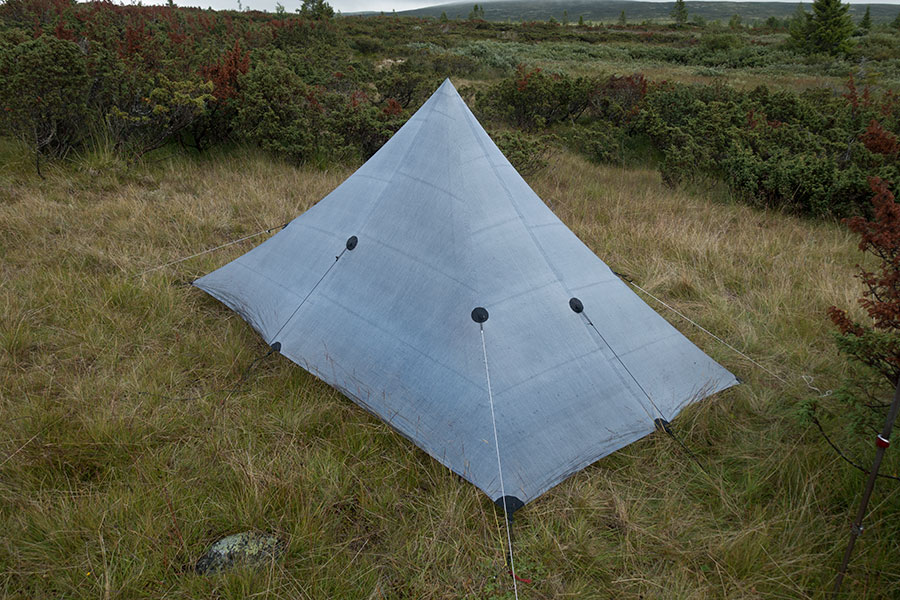
Fully staked and taut
The mid-panel and mid-ridge anchor points come equipped with a elastic loop. I’m not fully sure about the logic of it even though I understand they’re there to provide some give and avoid excessive strain concentrated in a spot to diminish the chance of failure at the expense of less support. I don’t know what’d be worse. I experimented getting rid of them but eventually re-installed.
Getting a good pitch is not as straightforward as I’d had expected for a 4 side, rectangular plan, symmetrical mid with a pretty much fixed geometry. I’m familiar with all sorts of shelters, including flat tarps, shaped tarps, asymmetrical mids and Trailstars where you need to be more creative than with the Khufu where I expected it’d be little more than staking the corners in a rectangular plan and install the pole but it turned out not so simple.
It’s surely about the DCF. Unlike silnylon, this thing has no elasticity and you really need to get the shape right, otherwise the setup gets out of shape, tension is not properly balanced and partial re-tensioning is not a solution. I often needed to reposition the corners. I also got better with practice.
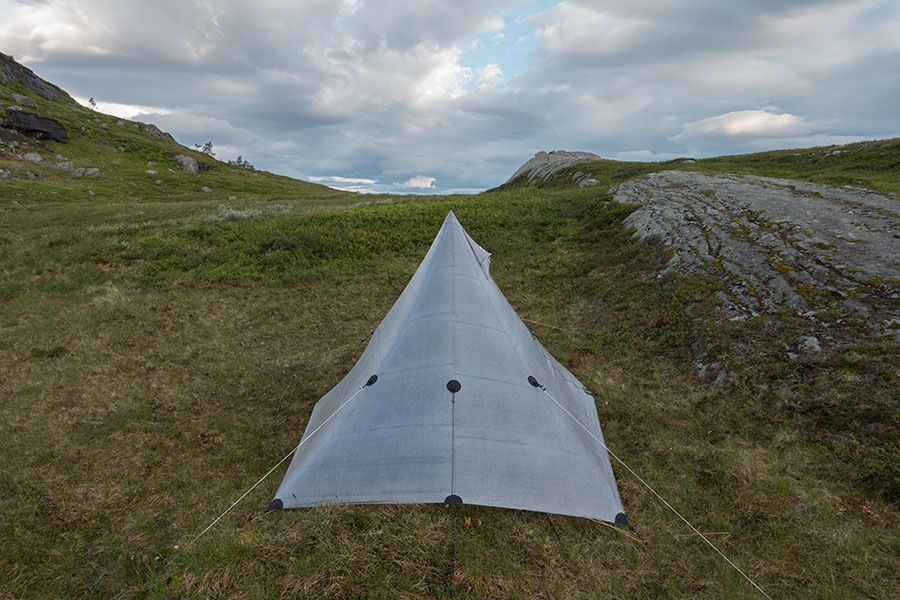
Getting the rectangle right
Room in the inner was fine for me. I could imagine people taller than 6′ touching the ends of the net tent when laying in the bag, particularly if they use a thick inflatable pad. Getting in contact with the fly walls would need taller users. This is probably not the tent for tall people though. I could sit down and transition back and forth from laying to sitting without touching the fly.
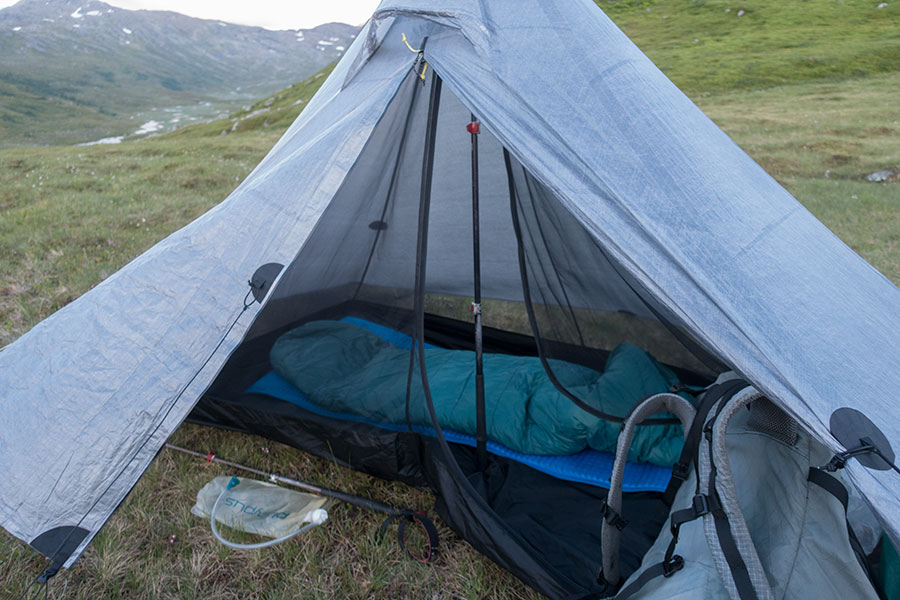
Inner tent
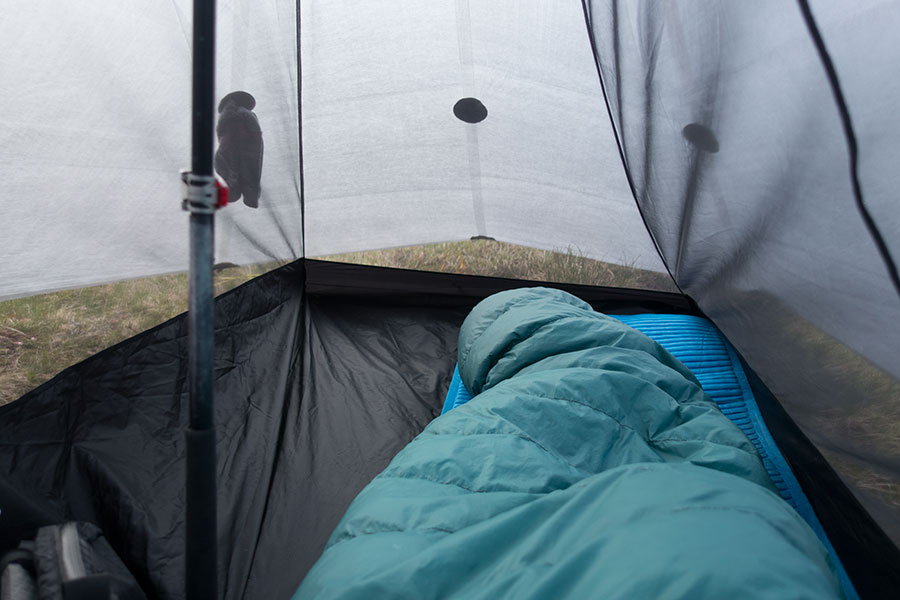
Inside room
The 2/3 area inner tent fits at the back, i.e. opposite the opening, leaving the 1/3 front as a vestibule that can hold a pack and allows cooking with reasonable care.
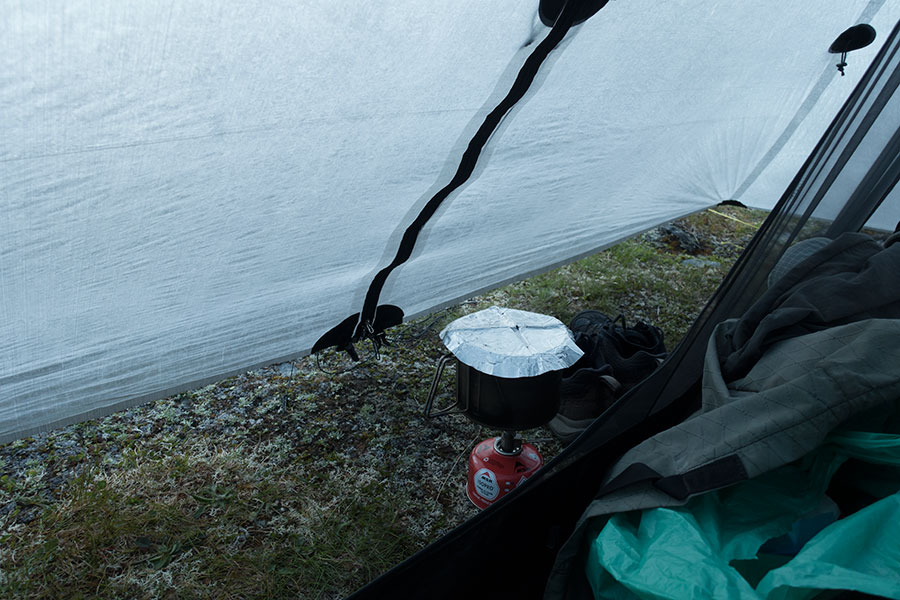
Vestibule cooking
The one thing I don’t like and still worries me somehow is the zip. It’s positioned mid-panel where tension is at its lowest, yet I feel the struggle it goes through every time I close it. Maybe it’s apprehensive me and I should not worry.
Having the buckle at the lower end closed during zip operation certainly relieves some of the strain. Sideways tension on the zip is something I take as a factor when pitching, trying to apply less tension on that panel at the price of compromising the geometry but every subtle millimeter helps.
The zip has shown no signs of failure yet.
Corollary
I loved using the Khufu. It made me feel safe and comfortable when I needed it, namely when camping in exposed, remote locations in sometimes unsettled weather. I felt confident I could use it in the Norwegian mountains, which is a lot to say about the shelter given the roughness of the place and the notoriously wimpy user.
I still need to use it in really challenging wind/rain conditions to see how it feels then.
Liner bag
This is an item that I’ve owned for a long time but hardly ever used, preferring sleeping clothes instead for the main purpose of keeping the sleeping bag clean and adding some insulation as a side effect. Norwegian huts require the use of a liner bag though and I wanted to have the hut option open so I included the liner bag in the list. It deserves the mention because, to my surprise, I loved using it in the tent.

Questionable home use of the liner
I didn’t go through night temps that challenged the sleep system, I think the main factor in enjoying the use of the liner was to know that I’d keep dirt & grime off the bag no matter what, including keeping some hiking clothes on for the night. I’m aware this latter may not sound like a great idea but I found it worked well for me some of the times. It may make sense if you think of the context: an environment that was never too warm, never dusty so I hardly ever felt uncomfortably dirty. Plus, evenings and mornings used to be chilly so avoiding the change of clothing had some edge, particularly in the morning, when I could keep the heat in during camp time.
Whatever it was, and I’m probably not able to articulate the whole of it, I liked using the liner to the extent that I’ve started carrying it as a choice.
Waterproof Top
I carried the Sierra Designs Elite Cagoule that I’ve had for some years already but have been keeping only for use in the big trips so I’d expect it’s not yet worn out. It doesn’t look like. The thing here is I think not so much with the item itself but the concept: lightweight waterproofs may be too thin to hold water for too long, be it about the face fabric, the membrane or both.
For a bit of context, I’m not expecting anything from bold claims about keeping you dry. I have it clear that water will eventually win, it only needs time, and the thing about waterproofs and rainy weather hiking must be about keeping reasonably warm and comfortable rather than dry, whatever the latter means.
I’ve been using lightweight waterproofs for a long time with relative success but well aware that rainy weather is a major challenge, particularly so in places with plenty of exposure and a big potential for rough weather like Norway.
In the summer of 2022, I went through some serious rainy episodes. Every time, I felt miserable and resorted to the huts if I had the chance. I couldn’t help thinking this was not acceptable and that I needed to improve my performance. I’m not sure how much of this improvement is about gear, how much about technique, how much about mindset but there’s most probably some of all three factors.
Next time I need to be self-reliant for extended periods of hiking time in conditions like those in Norway, I need to try something different.
 RSS – Posts
Say what you want