
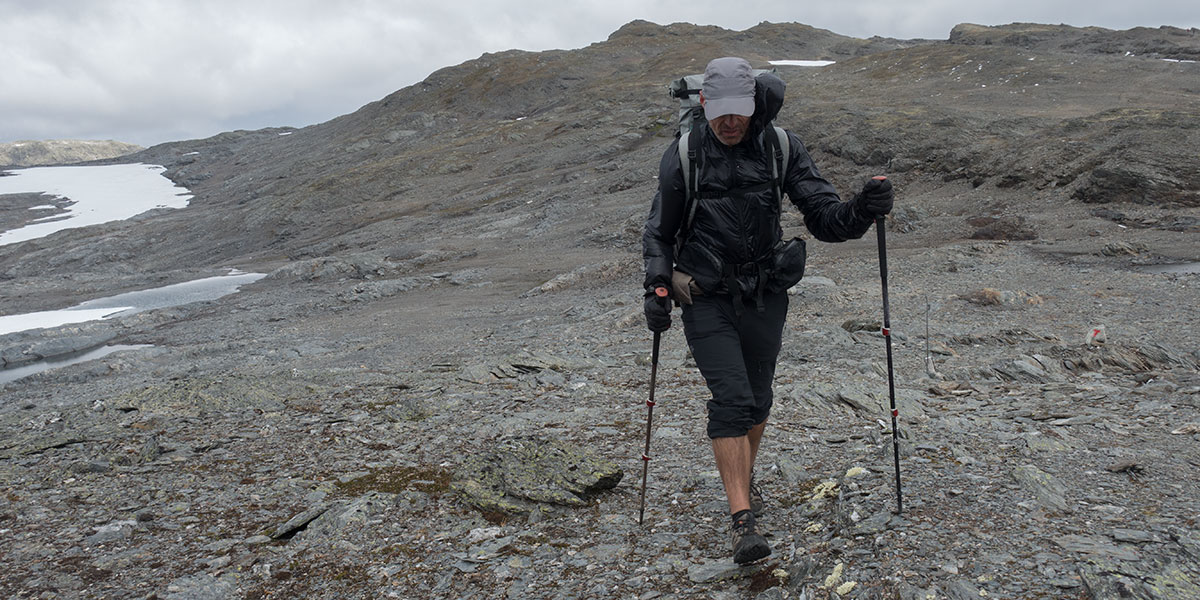
In the summer of 2025, I was back in Norway for some more quality hiking. This time, I went for its backbone, Norges Ryggrad. I started hiking in Jotunheimen, the main mountain region in the southern half of Norway, then across Skarvheimen, Hardangervidda and the Ryfylke highlands all the way down to Lysefjord, in the Stavanger area.
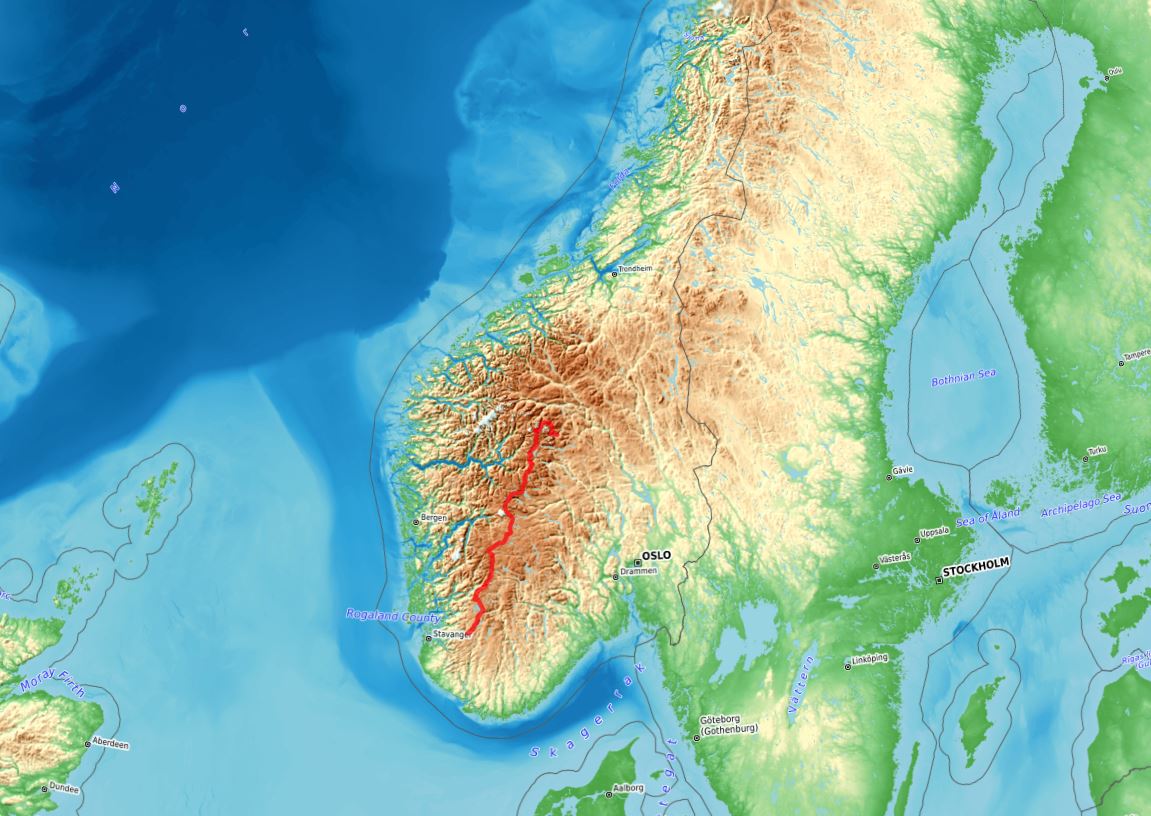
Jotunheimen to Lysefjord
With this trip and together with previous chapters, I’ve almost completed hiking the length of Norway with only the far north and south ends missing. In this entry, I’ll go through the outstanding features of the journey as I perceived them.
Challenging plan
I planned for the usual 30+ km daily average, which I already know is rather ambitious for me in Norway. Unlike previous trips in the region though, this time there wasn’t much room for Plan B. Once I was past km 343 at the Haukelivegen crossing, a full 128 km from route’s end, there was no easier way out than going forward.
This made for an interesting challenge. I needed to really push hard to get to that last trailhead feeling safe about keeping onwards. Weather and terrain can easily combine to slow a hiker down in Norway. I took advantage of a fair weather window and the flat, solid ground in Hardangervidda to build some cushion before that last road crossing, then went for it, even if the weather was not expected to collaborate anymore.
It went well and I made it to Lysefjord on time.
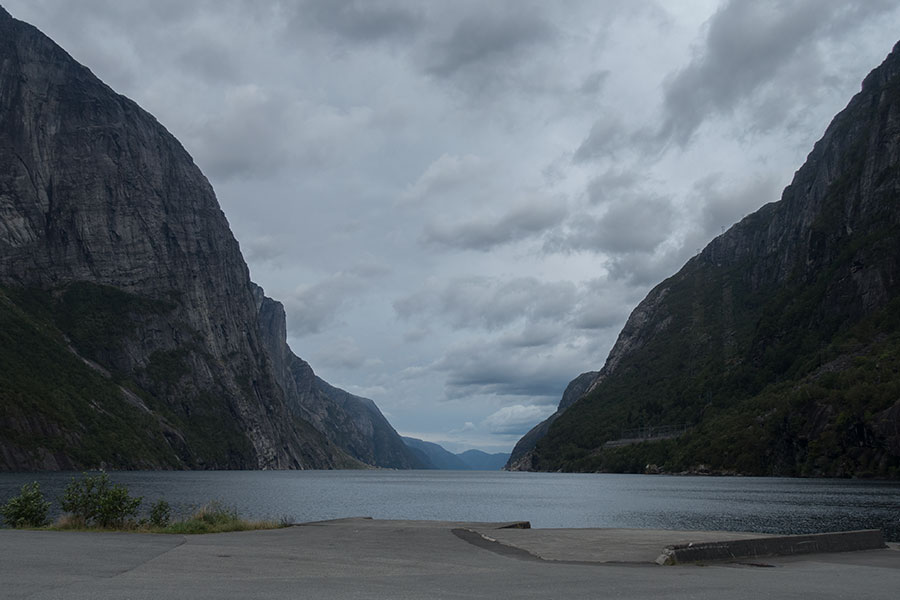
End of the line in Lysefjord
A deal
The route plan was too nice to give up on it without a good try but I was well aware it could be more of a struggle than I’d like. At some point in the planning, I started using the idea that, if I was to keep my options intact, everything needed to go well. And I meant “everything” trip related: weather, obstacle dodging, gear performing, injury avoiding and proper decision making. All of that going well, I’d have my chance but it’d still be hard work.
At some other point, during the actual trip, I started seeing it as a deal between me and the universe: if everything would go well, I’d commit to my part. I’d work hard, I’d keep calm and take good decisions.
I’d spare talking to the outside elements, be them weather, bogs or boulder fields because I wouldn’t expect them to listen but I’d routinely keep a dialogue with my team to request feet, shoulders or hamstrings, pack, shoes or poles to hold tight and stay healthy all the way to trip’s end. There would be an end. Everyone answered without much complaints.
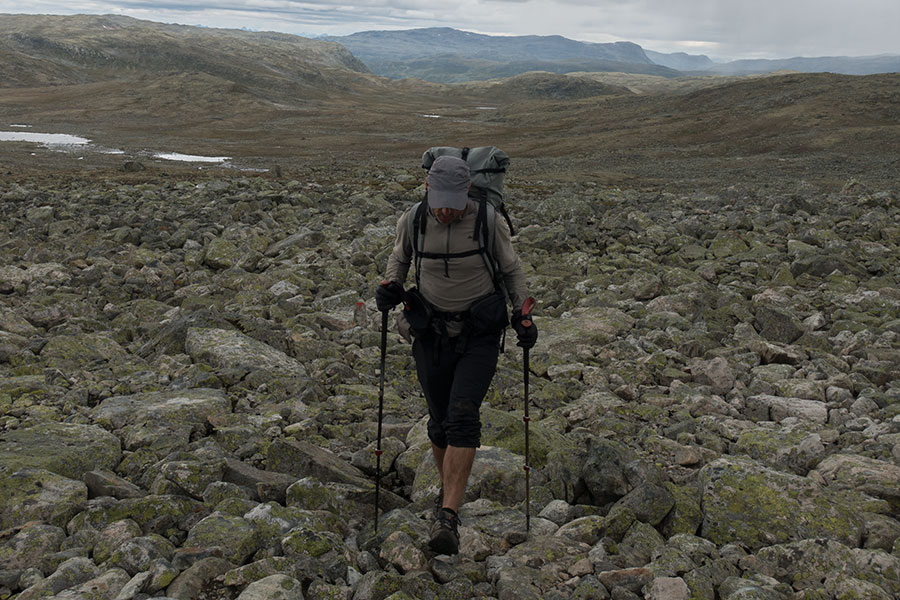
The full team, working hard
Only a few days after getting back home, I busted my left knee during a day walk in uncompromising terrain1.
The Backbone
Southern Norway’s backbone may not be a very obvious one because the mountains reach west all the way to the North Sea, yet there’s this line of highlands and mountains from which water flows east or west. Traditionally, that’s where some of the best hiking is found.
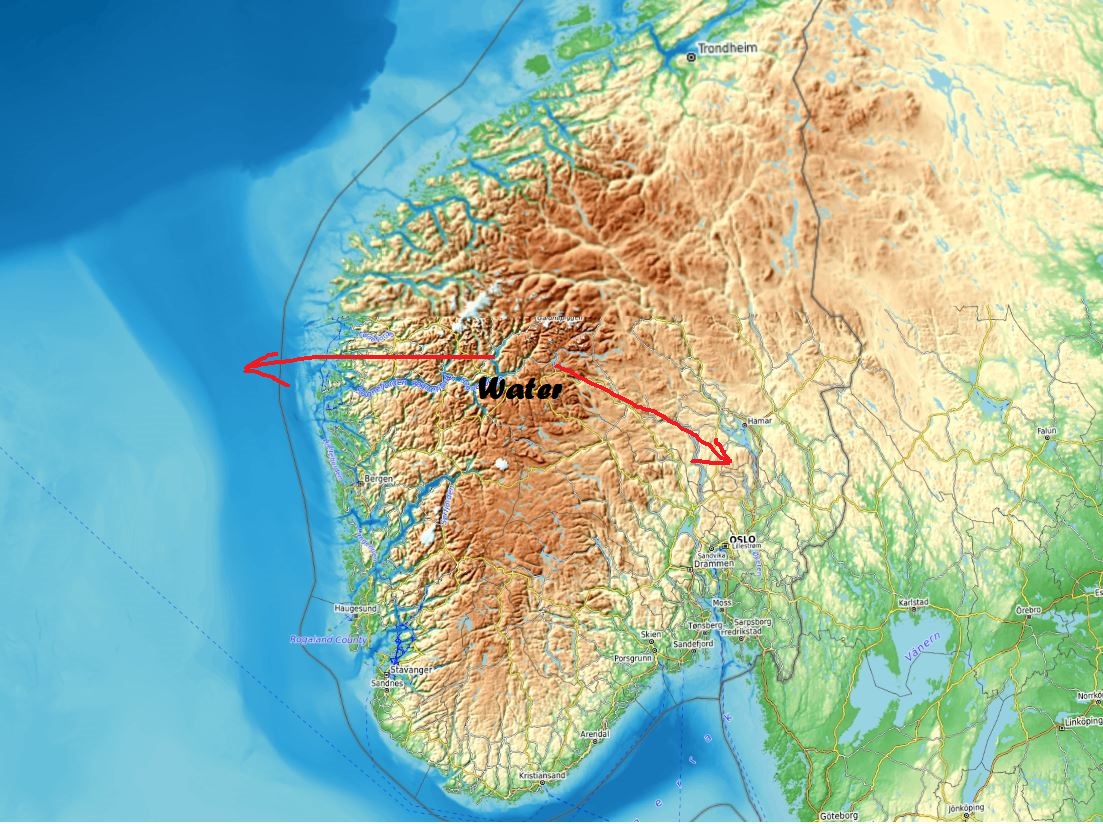
The Backbone
The Norwegians marked some trails in this territory, I just followed them. Norges Ryggrad.
The not so obvious link
The core idea behind this trip was to traverse Jotunheimen and Hardangervidda, mountains and plateaus I had never visited before, but my time window allowed, actually asked for an extension and I kept following trails over the maps southbound until I found an stylish end point that felt doable. At the time of planning, I wasn’t aware I was meaning to link areas that were farther away from each other emotionally than they were geographically.
Jotunheimen is a clear unit, Hardangervidda is another and both can be seamlessly joint in a single hike. When I mentioned to fellow hikers along the way my end goal being Lysefjord, I got nods and grins about how far that was. Thinking back, I feel it was more about the emotional distance than the physical. South of Hardangervidda, I entered what felt like an entirely different stage in the trip, in a less travelled area where I went down valleys that took me to woodland and, if only briefly, farmland. Climbing up to the Ryfylke plateau felt like emerging onto a new world with a character of its own that seemed well away from the other regions.
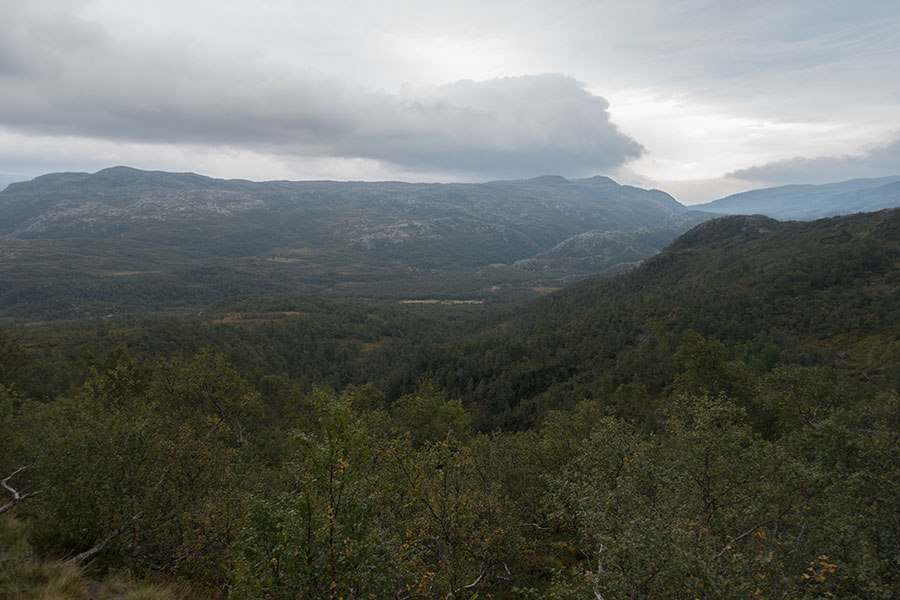
Linking grounds
Once up in the Ryfylke plateau, I met hiking traffic again.
Popular Norway
Of all my trips in Norway, this has been the one where I’ve met the most people on the trails and huts, by a rather long shot. This doesn’t mean there were crowds anywhere except maybe the Bessegen route in Joutunheimen, which I went through in fair weather on a Saturday morning and against the main flow of hikers but this was an outstanding exception.
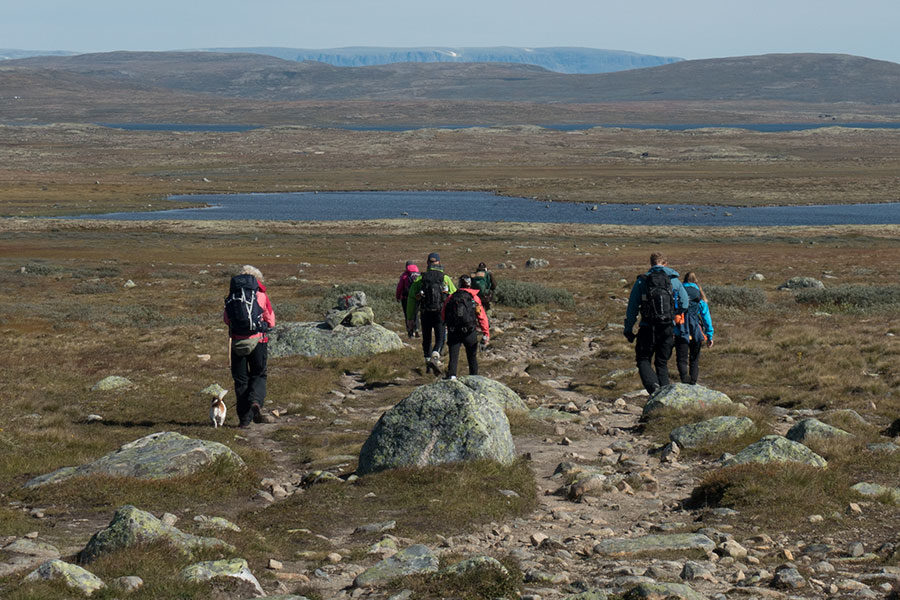
Norwegian-sized crowds in Hardangervidda
The main idea here is that all my previous trips were very solitary, not so this time. I’d count on Jotunheimen being popular but the regular flow of hikers continued, if only to a lesser extent, through Skarvheimen, Hardangervidda, Haukelifjell and even the Ryfylke plateau. I’d also meet camping parties in several occasions, which had proved a hard find in previous trips.
I reckon the following point below may have something to do.
Dry feet
Of all my trips in Norway, this has been the only one where I’ve kept mostly dry feet throughout. As much as I’m used to take wet feet as part of the deal, keeping them dry was certainly welcome news.
Two main factors come to mind, one being the consistently upland terrain, more rock and less marsh than lower areas. Even the Hardargervidda plateau, which is mostly flat, was very solid underfoot and the few marshy sections I found were equipped with wood planks. This brings me to the other relevant element which incidentally links with the idea above about the relative popularity of the region. Don’t expect a hiking highway, the trails are the usual Norway-rough but there are bridges over most streams and I only had to wet my feet in a ford when I briefly went off-trail for an obvious shortcut.
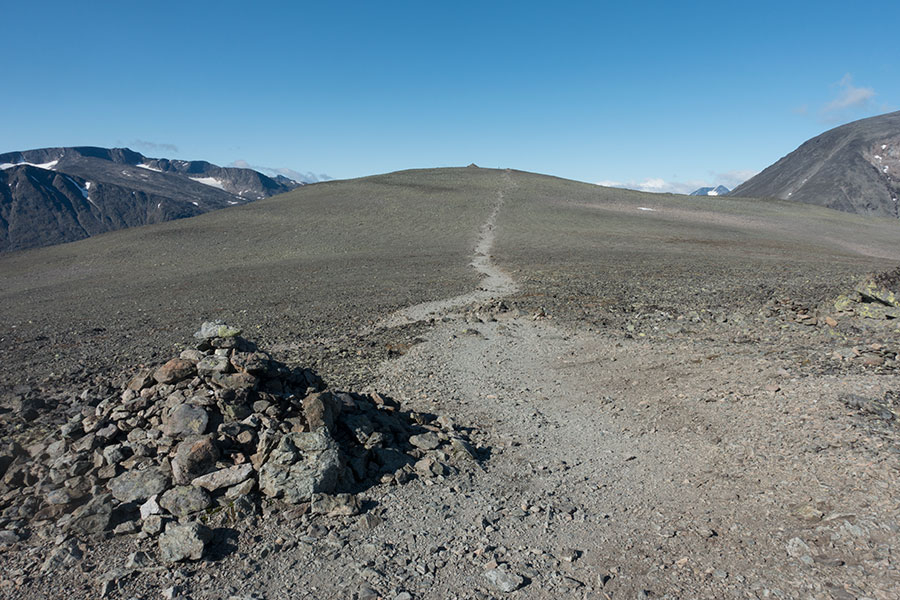
High & Dry in Jotunheimen
Rain alone can make a wet mess of any trail but this wasn’t a particularly rainy trip.
Cold and Dry
Grosso modo, this is about 180 degrees from the typical conditions I’ve met in my previous trips in the Norwegian summer, which tended to be mild and wet. This one has probably been the coldest summer trip I’ve ever done overall, up there with the Iceland crossing. Not deep but sustained cold.
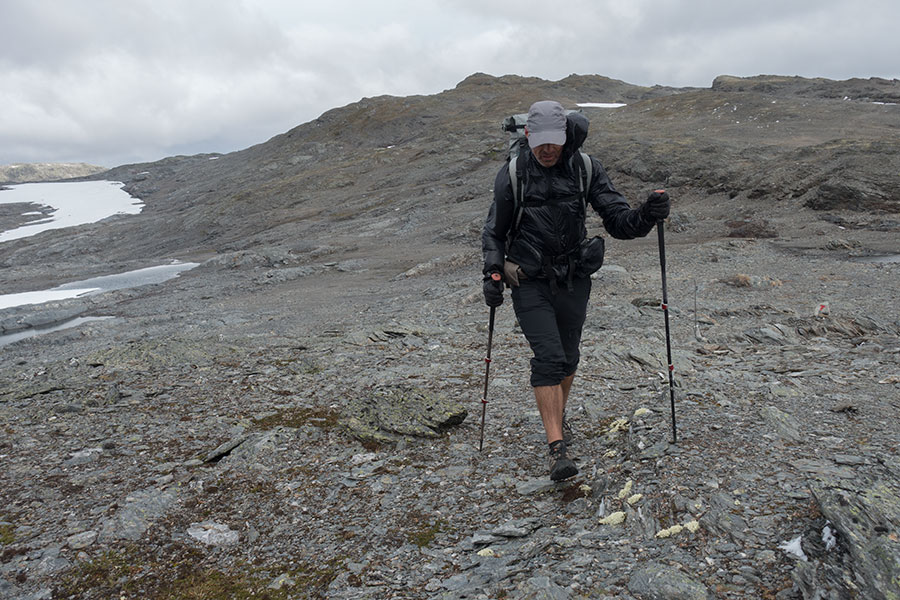
Don’t get misled by the exposed legs, it was cold
I’ve certainly been through cold spells in many occasions before and the high mountains tend to be routinely cold at times and spots but this one’s been different. Beyond my perception of the conditions, there’s been a clear indicator in the use of my warm layers. I count on them as standard in my kit because I know they’re key when the time comes but I keep thinking on how little use I sometimes get out of stuff like a fleece top or a pair of gloves. In the Norway Backbone, I lived in them for extended periods.
It was also mostly dry until the final four days and even then the rain was patchy and I was lucky enough the longest episodes happened at night.
Overall, it’s the most favorable conditions I’ve ever met while hiking in Norway.
Better flow, less struggle
I had been struggling big time in latest years with my long distance hikes, a mix of over-ambitious plans, tough conditions and my own limitations, and 2025 was bound to be similar. Somehow, to my welcome surprise, this trip went much better in all accounts. I can certainly thank the weather as the best I’d ever had in Norway, it only slowed me down by the latest stages, when I could already afford it, but I feel I can also be thankful to myself. I concentrated on keeping confident and on taking good decisions.
The best outcome of the trip was not about making it to my planned end point but about the process of getting there. It was hard work but it went rather smoothly and I was very happy about this.
 RSS – Posts
Say what you want